QIDI Q3D First Look: Dual Nozzles and a 70 °C Chamber
QIDI's Q3D adds a second nozzle and a 70 °C chamber. Specs, presale price and what it means for makers, from drone frames to Meshtastic and MeshCore cases.
On this page
- The Short Version
- Who the Q3D Is For
- What It Means for Mesh Builders
- What’s New on the Q3D
- Two Nozzles, Two Filament Paths
- Supports That Peel Away
- 350 °C Quick-Swap Hotend
- A 70 °C Chamber
- Leveling and Motion
- Filtration and Safety
- The Smart Stuff
- QIDI Box for More Colors
- If a Q3D Lands on Our Bench
- Q3D vs Q2
- Price, Presale and Shipping
- Full Specs
- The Bottom Line
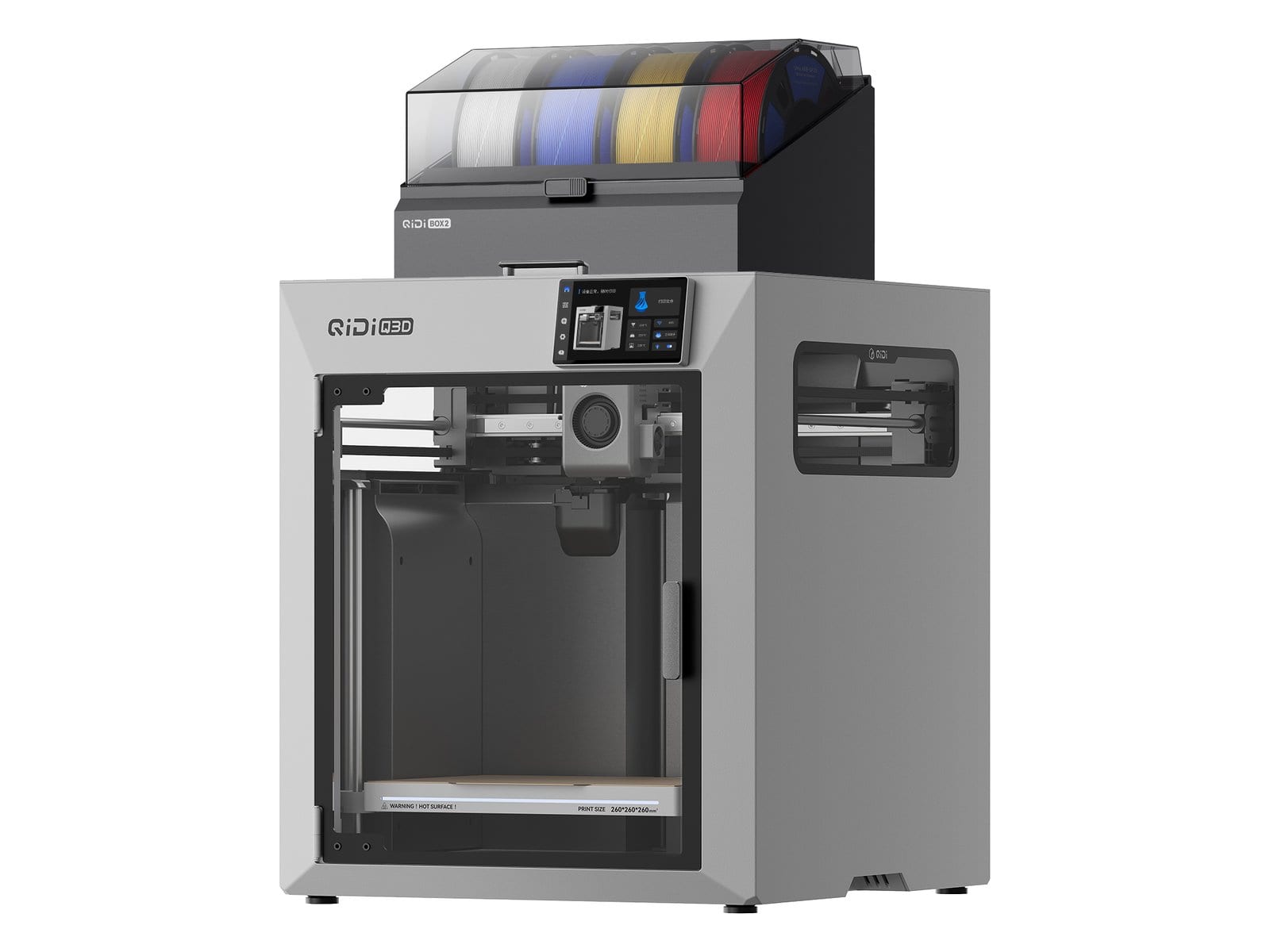
Image: QIDI
QIDI launched the Q3D at Formnext 2026 in Frankfurt today. It takes the ideas behind the QIDI Q2, the printer we make our Meshtastic and MeshCore node cases on, and adds the one thing the Q2 doesn’t have: a second nozzle.
In more than three months on our Q2, every failed print traced back to us, never to the printer. Our QIDI Q2 review has the details.
We don’t have a Q3D yet. Everything here comes from QIDI’s product page, its FAQ and the launch announcement, and all photos in this post are QIDI’s. We’ll say plainly where something is QIDI’s claim. QIDI sent us the Q2 we reviewed, with no conditions on what we wrote. Links to QIDI’s store are NodakMesh affiliate links, and the price is the same for you either way.
The Short Version
- Two hotends, two filament paths, so switching materials doesn’t mean purging.
- Supports from the second nozzle, in PVA or a support filament that peels away.
- 70 °C chamber, up from 65 °C on the Q2.
- $599, or $529 on presale. QIDI estimates shipping about three months after the balance is paid.
Who the Q3D Is For
Two-color signs, labels and products. The second color comes from the second nozzle, so there’s no purge between colors.
Parts with internal cavities. Breakaway or PVA supports from the second nozzle let drone frames and enclosures come out clean inside.
Grips and bumpers. QIDI lists TPU 64D for both hotends, so a rigid shell and a TPU grip or bumper can print as one part.
Brackets, drone arms and car parts. QIDI aims the 70 °C chamber at engineering nylon, the material for parts that take load and heat.
Classrooms, makerspaces and home offices. The 3-in-1 filter and flame-retardant chamber suit a shared room, and the AI camera watches for failed prints.
Ham radio. Stands, antenna mounts and mic clips for handhelds like the BTech BF-F8HP Pro are small parts full of overhangs, and clean supports help.
What It Means for Mesh Builders
- Two-color cases. Our gray case with red buttons becomes one print.
- Labels that last. A node’s name, channel or contact line in a contrasting color can’t peel off like a sticker.
- Clean inside surfaces. Breakaway or PVA supports come out of battery bays, cable channels and snap-fit clips by hand.
- Rigid and flexible together. An ASA or PETG shell with TPU bumpers or a cable strain relief, in one print.
- Mounts that take a load. PCTG from our filament guide still suits most outdoor boxes; the 70 °C chamber adds nylon for mast clamps and solar brackets.
Our 3D printing page has more than 70 free cases and mounts for Meshtastic and MeshCore boards.
What’s New on the Q3D
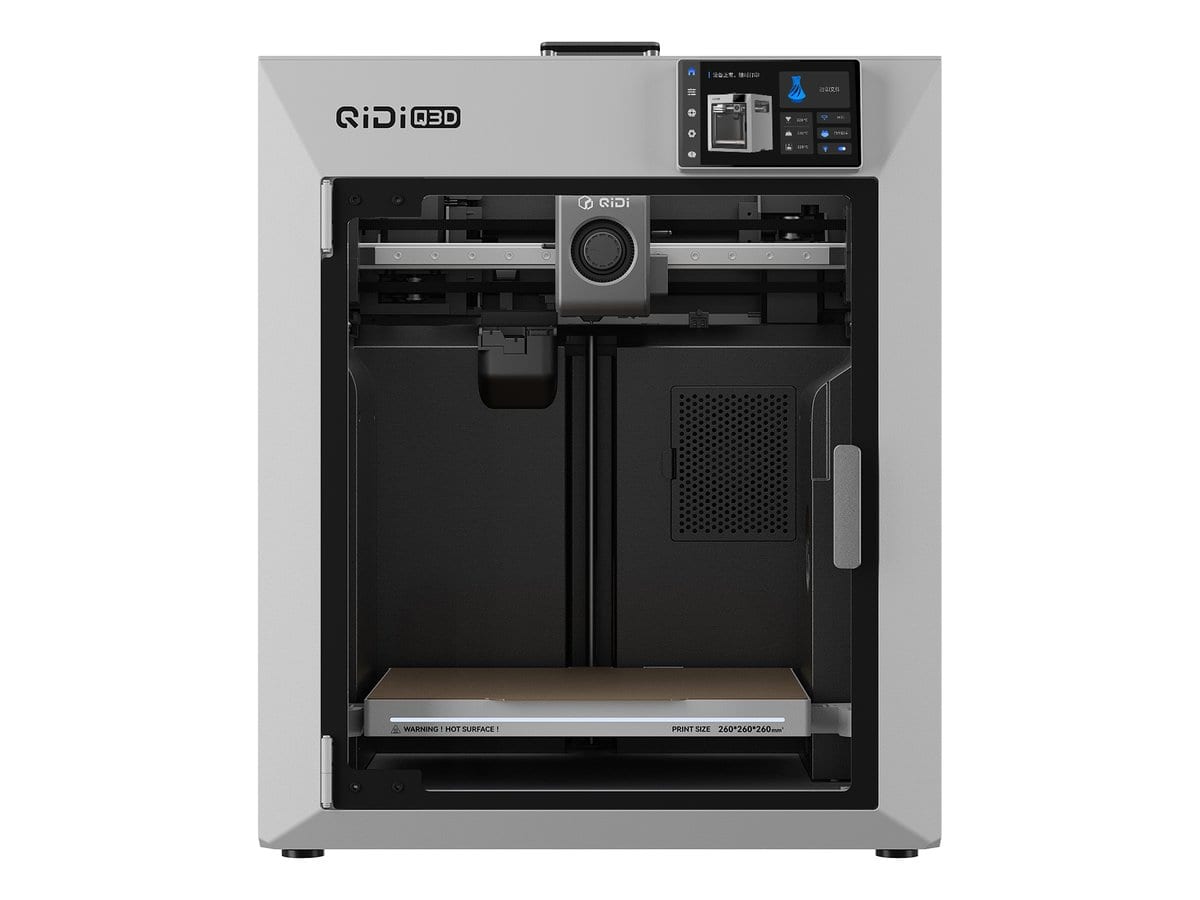
The Q3D from the front. Image: QIDI.
Two Nozzles, Two Filament Paths
A single-nozzle printer with a multi-color unit, like the Q2 with a QIDI Box, purges filament on every color change, which costs material and time.
QIDI says the extruder modules and filament paths are physically separate, and each nozzle runs at its own temperature. QIDI calls it zero purge, zero waste, and claims dual-material prints run up to 40% faster than traditional dual-color printing.
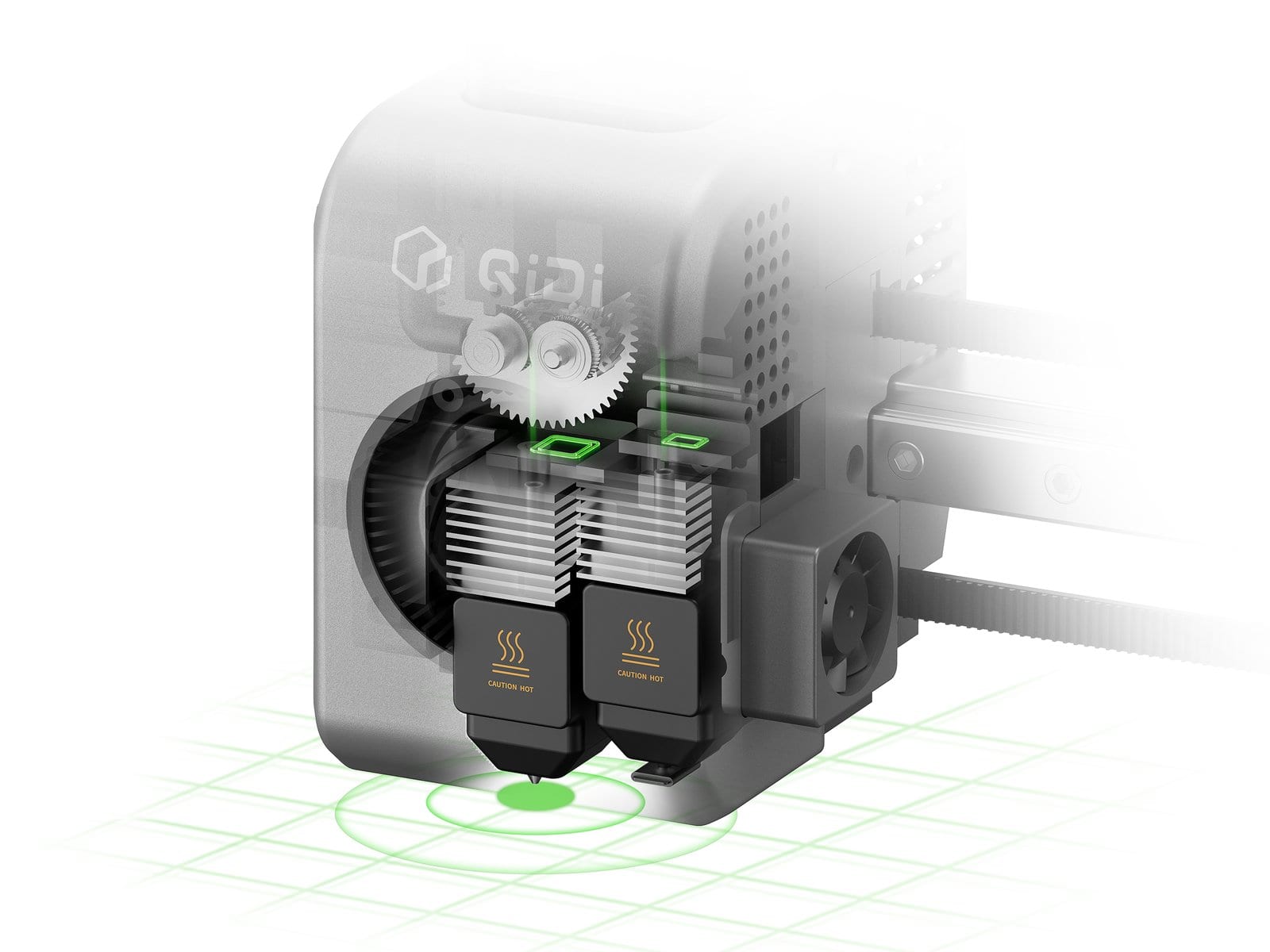
The Q3D’s dual-hotend toolhead. Image: QIDI.
QIDI’s own example is a drone frame. Against a conventional dual-nozzle print of the same frame, QIDI claims the Q3D used 41% less material and finished 52% faster. The toolhead is built to be light, which QIDI says keeps extrusion steady and cuts ghosting and ringing when it changes direction at speed.
Supports That Peel Away
For supports on the second nozzle, QIDI lists PVA, which dissolves in water, and dedicated support filaments for PLA and PETG, ABS, and PA and PET. QIDI says the supports snap off by hand and leave undersides smooth enough to show off.
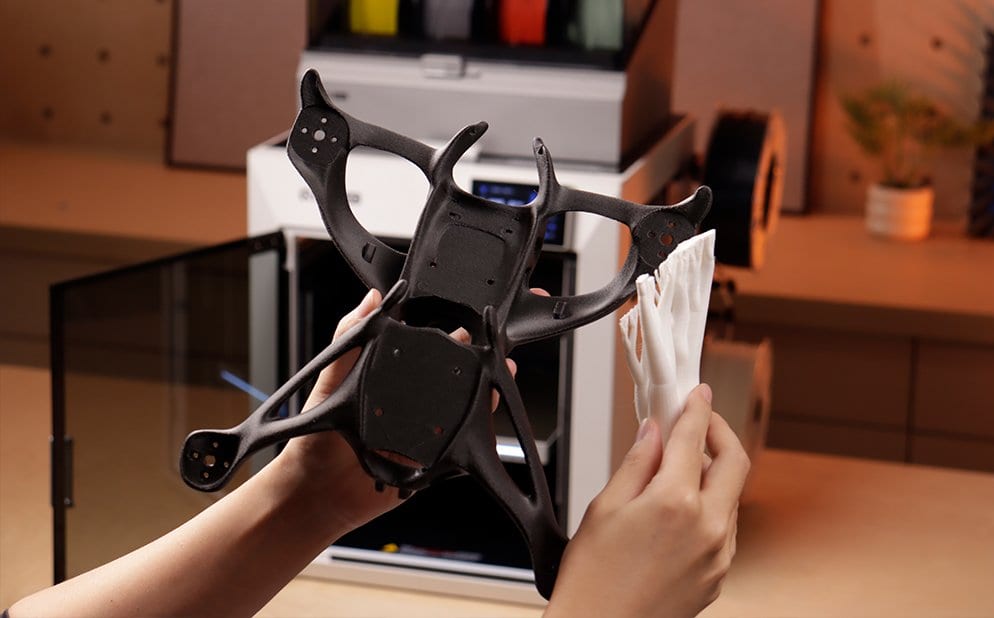
QIDI’s drone frame, with its supports printed from the second nozzle. Image: QIDI.
350 °C Quick-Swap Hotend
The main hotend swaps nozzles tool-free in seconds, according to QIDI. QIDI says the hotend heats from 30 °C to 220 °C in about 40 seconds.
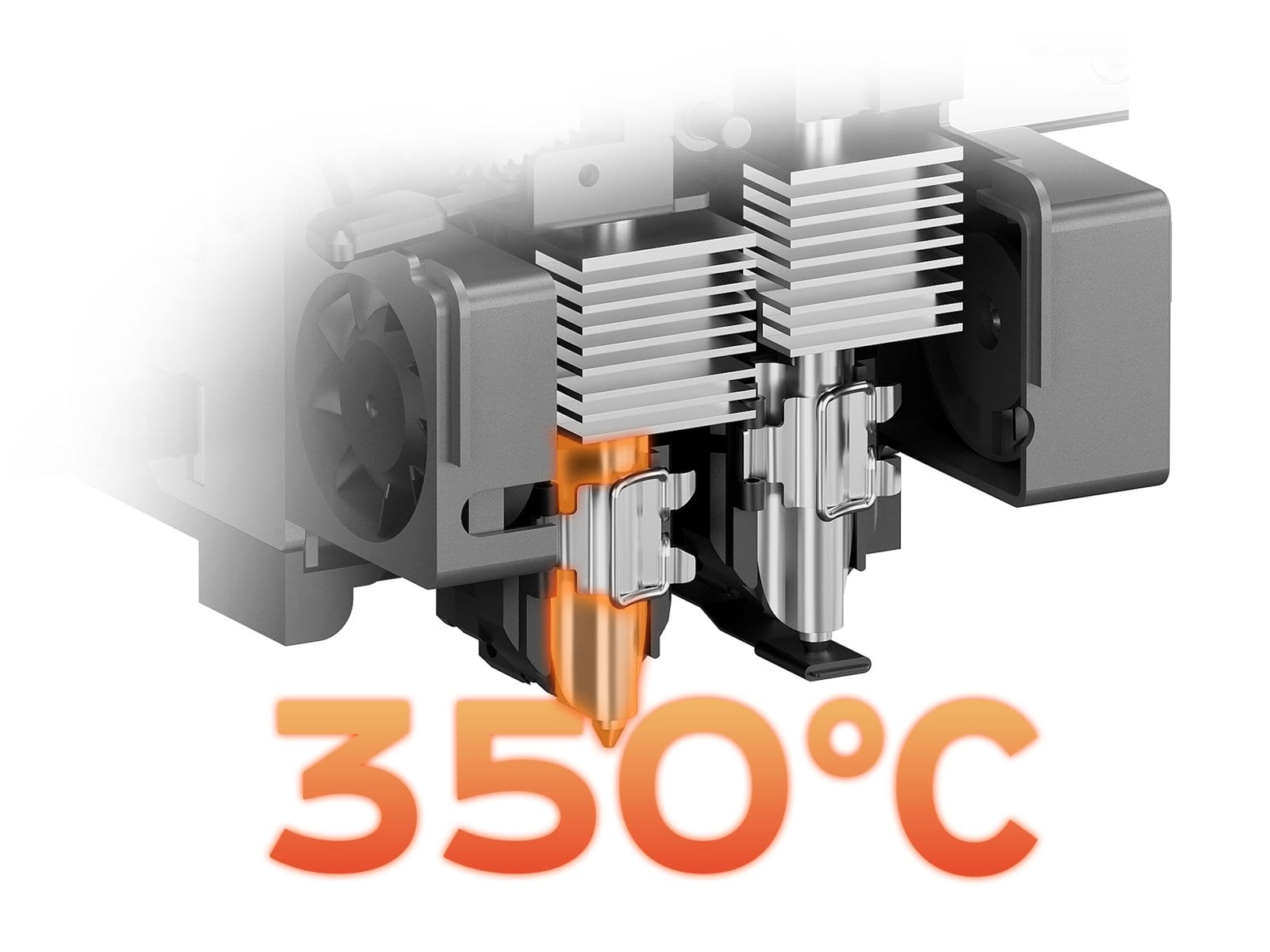
The Q3D’s main hotend reaches 350 °C. Image: QIDI.
For the best results, QIDI recommends running PLA Silk, PETG-CF, ASA-CF, PA6-CF, TPU 64D and PA/PET support on the main hotend.
A 70 °C Chamber
QIDI aims the chamber at engineering nylon, and says it means less warping and no layer cracking from everyday PLA up to PA.
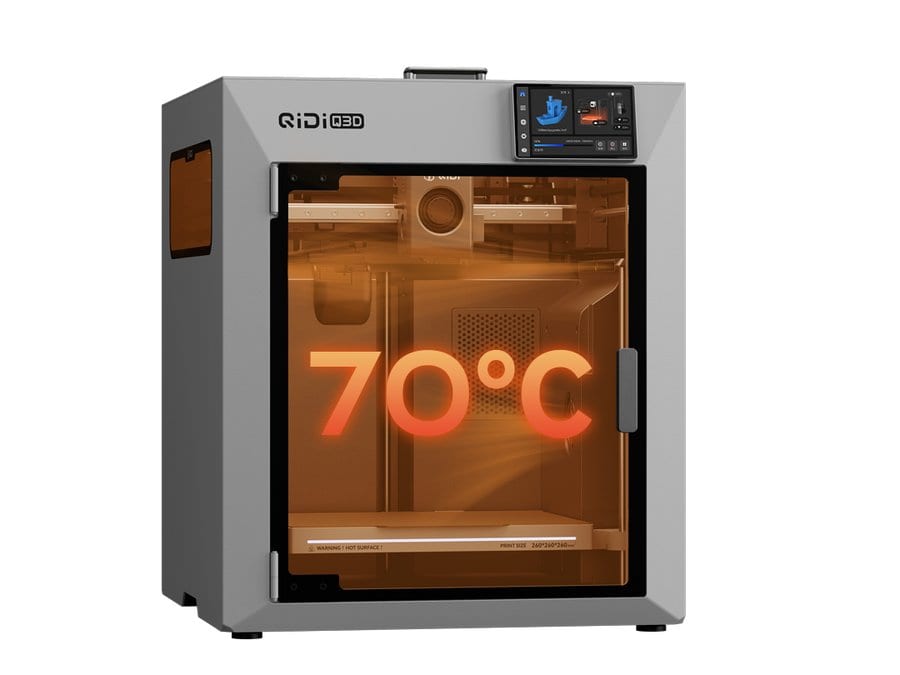
Fourth-generation chamber heating, up to 70 °C. Image: QIDI.
A hot chamber can soften PLA in the extruder. Extruder climate control blows cooled air through a dedicated channel straight onto the extruder, and QIDI claims it cuts heat-related clogs by up to 90%. QIDI’s FAQ says the extruder cooler uses its Polar Cooler accessory, so pick the Polar Cooler Bundle if you plan long PLA prints in a warm chamber.
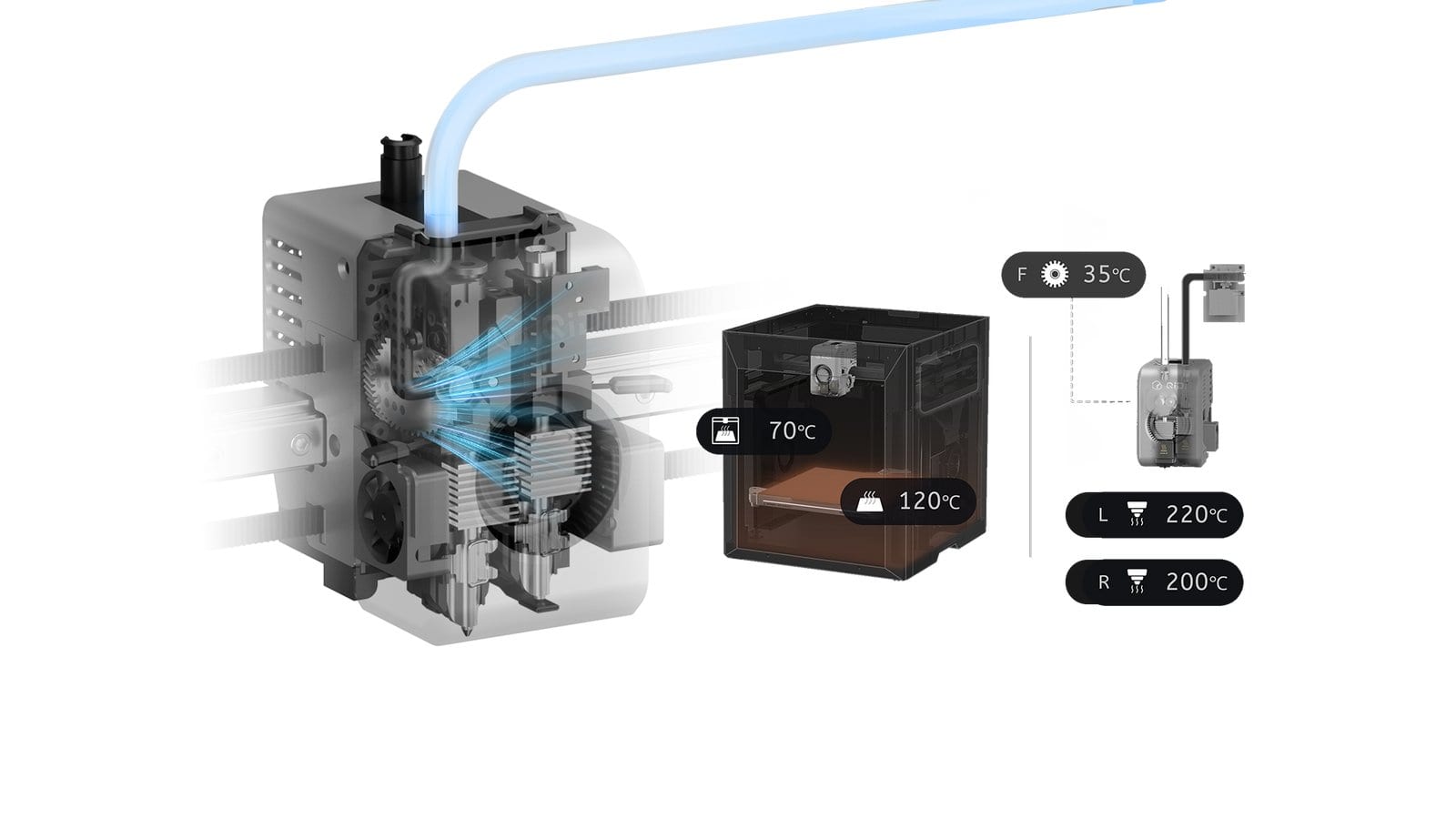
Extruder climate control, with live readouts for both nozzles. Image: QIDI.
A dual external air intake pulls outside air in to cool the part. QIDI says that makes for crisp overhangs and flat bridges.
Leveling and Motion
The eddy current sensor sits in the hotend. QIDI says it measures the build plate directly with the nozzle, so there’s no offset compensation, and its updated algorithm maps the bed automatically for a clean first layer. Input shaping is standard, and QIDI says its rails and vibration compensation give sharp corners and smooth walls at speed.
Filtration and Safety
The Q3D keeps the Q2’s 3-in-1 filter. QIDI says it captures 99.5% of dust, ultrafine particles and odors. The chamber is flame-retardant, with thermal monitoring.
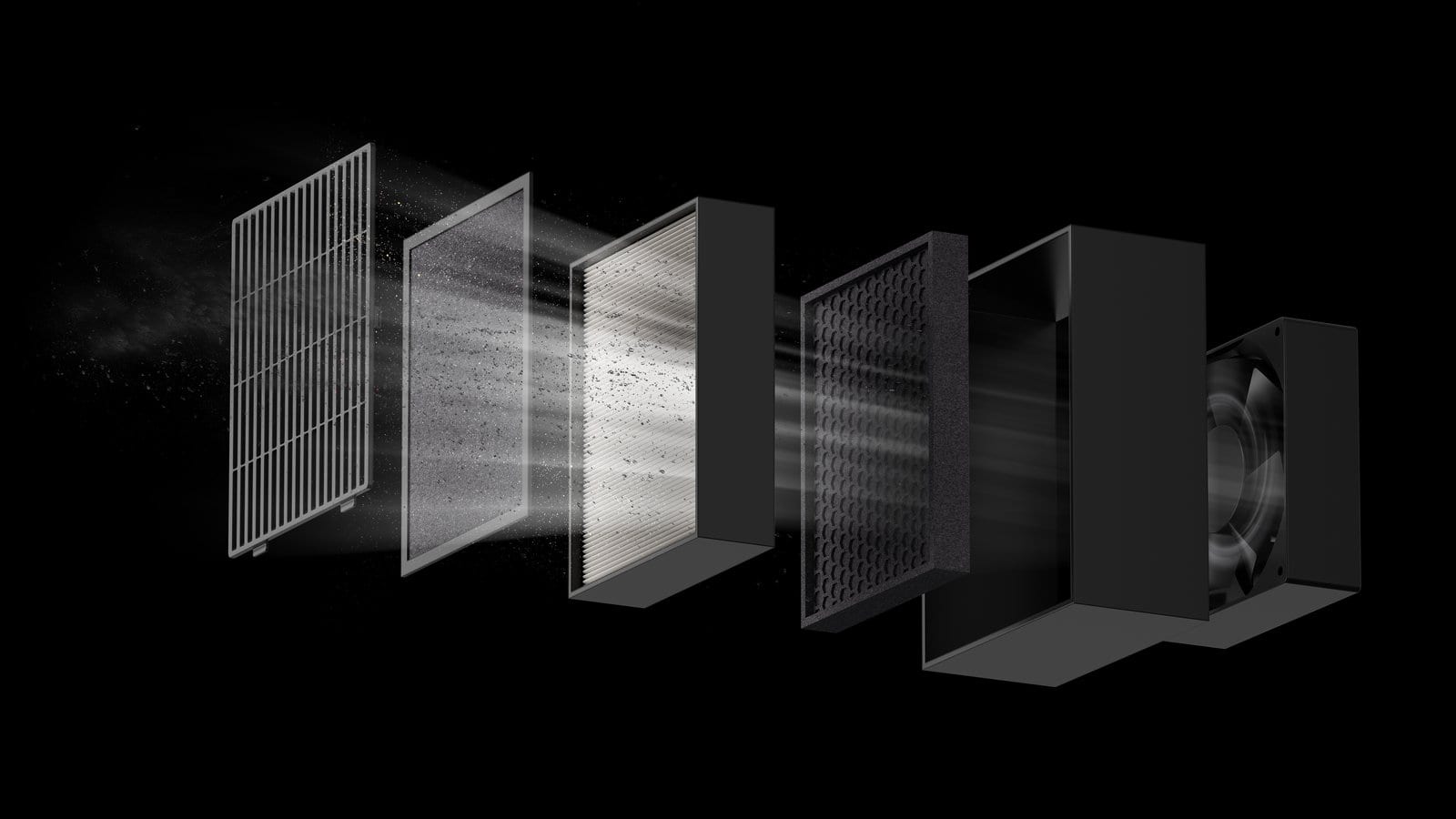
The 3-in-1 filter. Image: QIDI.
The Smart Stuff
- AI camera: watches for failed prints and records timelapses.
- Full-color touchscreen: 800 x 480, a big jump in resolution over the Q2’s 480 x 272 screen.
- Wi-Fi: dual band, with QIDI’s phone app and PC control.
- Sensors: filament run-out, power-loss recovery, and tangle detection with a QIDI Box.
- Slicers: QIDI Studio, with PrusaSlicer and OrcaSlicer also supported (QIDI notes some advanced features may not work in third-party slicers).
QIDI also says acoustic-dampened motion and low-noise fans make the Q3D quiet enough for a study, with pets asleep nearby. We’d like to put a sound meter next to that claim.
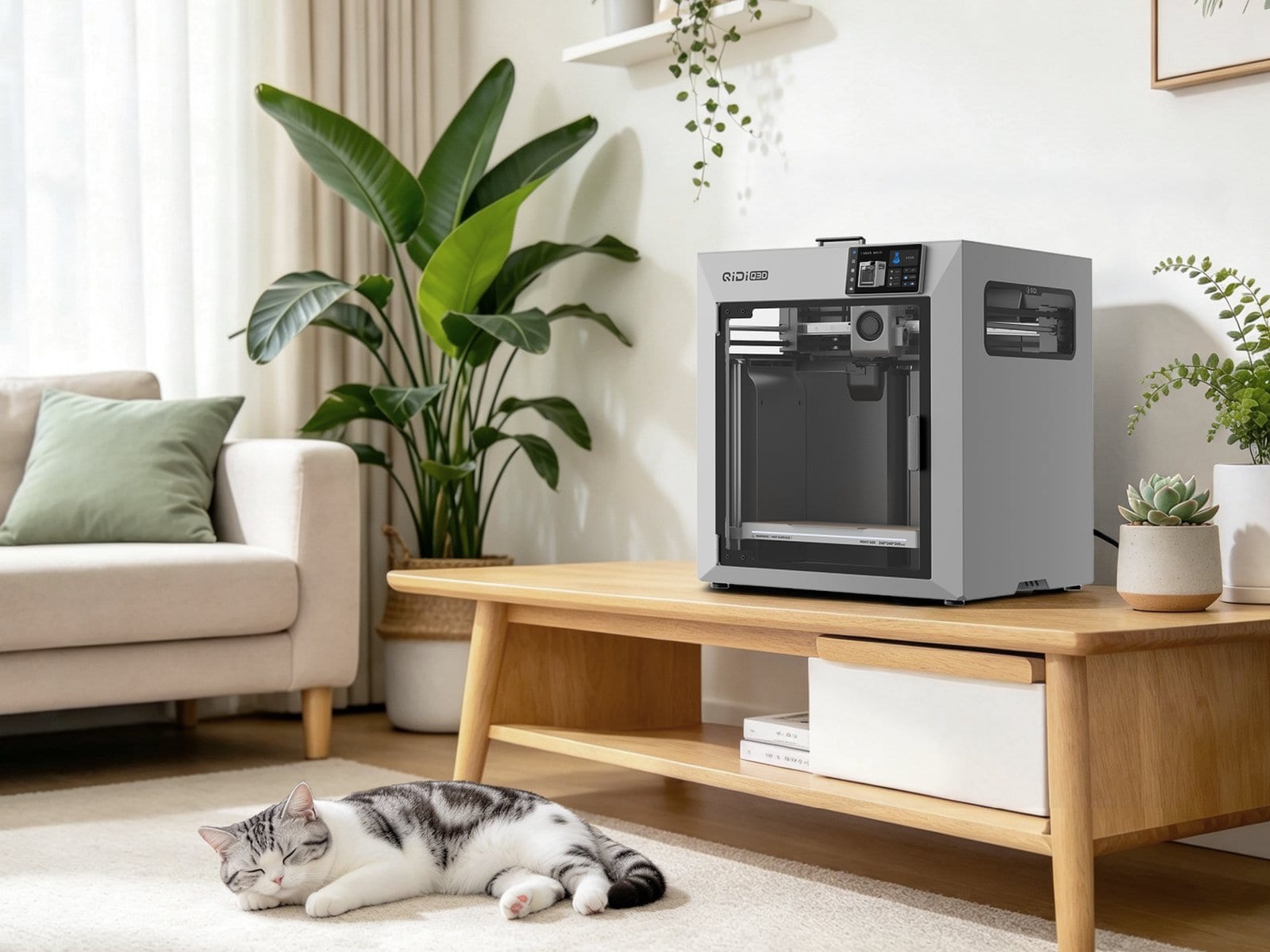
QIDI pitches the Q3D as quiet enough for the living room. Image: QIDI.
QIDI Box for More Colors
For more than two materials, the Q3D works with the QIDI Box. QIDI says up to four Boxes can connect, for as many as 16 spools. The Box also heats its spools to keep filament dry, which targets the wet filament behind most of our failed Q2 prints. The Q3D Combo is $749, and QIDI’s Combo photos show the printer with a Box on top.
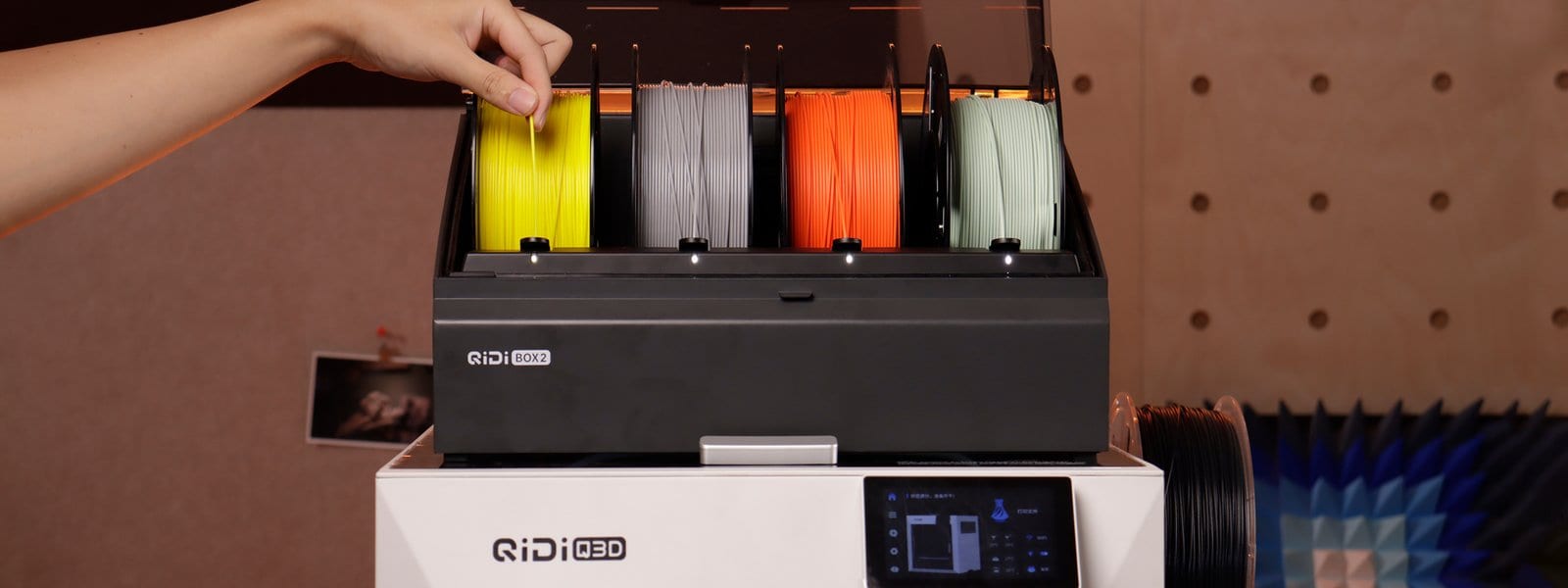
A QIDI Box on top of the Q3D. Image: QIDI.
If a Q3D Lands on Our Bench
- Our gray case with red buttons against the Q2 with a QIDI Box: print time, filament used and waste.
- A battery-bay case with breakaway and PVA supports.
- An ASA case with TPU 64D grips, to test the bond.
- Carbon-fiber nylon mast clamps on a repeater through a North Dakota winter.
- Three months of node cases, the same way we ran the Q2.
Q3D vs Q2
| Spec | QIDI Q3D | QIDI Q2 |
|---|---|---|
| Nozzles | 2, independent | 1 |
| Build volume | 260 x 260 x 260 mm (240 x 260 x 255 mm with both nozzles) | 270 x 270 x 256 mm |
| Chamber | Active, up to 70 °C (4th gen) | Active, up to 65 °C (2nd gen) |
| Hotend | Up to 350 °C, quick-swap | Up to 370 °C |
| Leveling | Eddy current sensor in the hotend | Load cell in the hotend |
| Speed | 600 mm/s, 20,000 mm/s² | 600 mm/s, 20,000 mm/s² |
| Filtration | G3 + H12 HEPA + activated carbon | G3 + H12 HEPA + activated carbon |
| Screen | 4-inch, 800 x 480 | 4.3-inch, 480 x 272 |
| Storage | 64 GB eMMC | 32 GB eMMC |
| Connectivity | Dual-band Wi-Fi, USB | 2.4 GHz Wi-Fi, Ethernet, USB |
| Multi-color | 2 nozzles, plus the QIDI Box | QIDI Box |
| Size and weight | 500 x 488 x 558 mm, 29 kg | 402 x 438 x 494 mm, 18.1 kg |
| Price | $599 ($529 on presale) | $449 |
Specs and prices are QIDI’s, from its US store on November 17. The Q3D is bigger, so measure the shelf.
Price, Presale and Shipping
- Q3D: $599. The presale takes a $30 deposit that turns into a $100 credit, so you pay a $499 balance when QIDI emails the payment link, for $529 total. The deposit is 100% refundable at any time, and the balance is due within seven days of the email.
- Q3D Combo: $749. Both come in Standard or a Polar Cooler Bundle.
- Shipping: QIDI estimates about three months after the order is placed and paid in full.
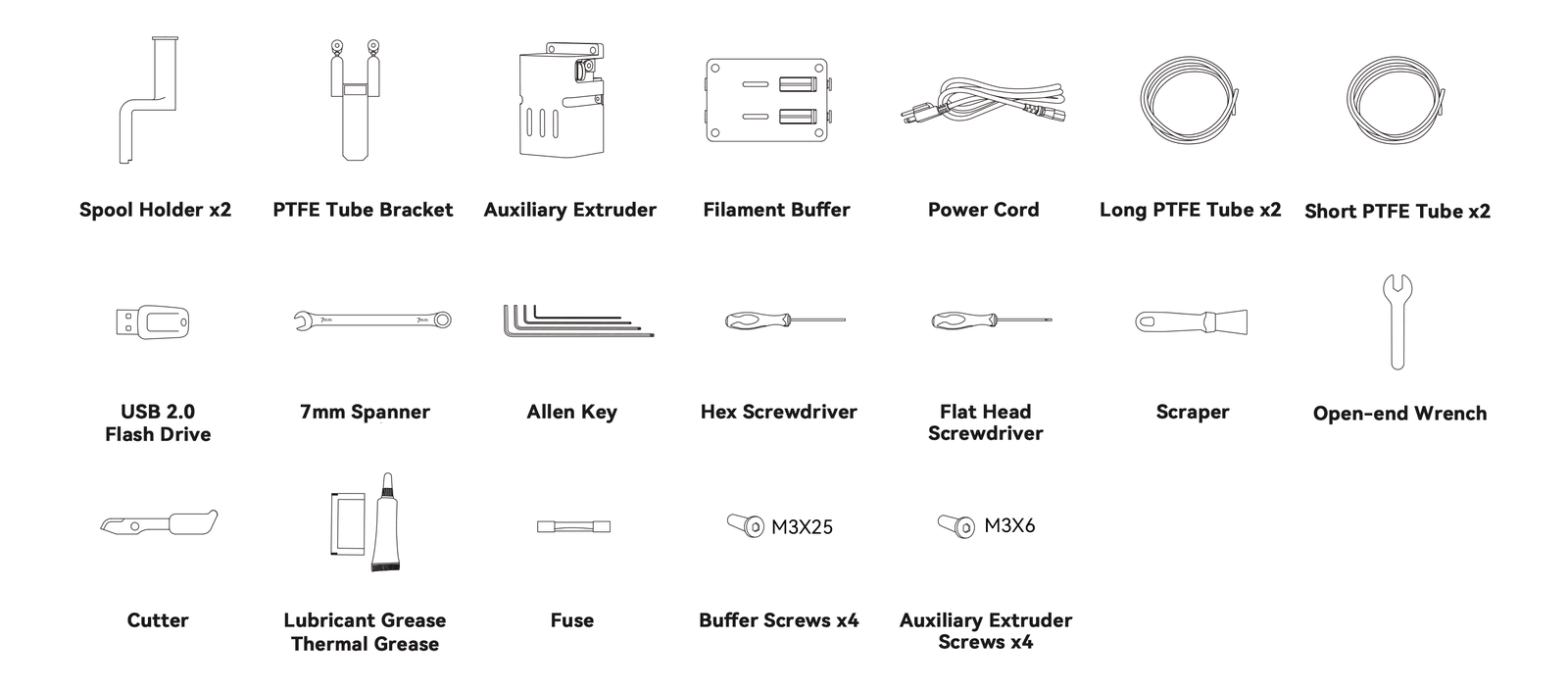
What’s in the box. Image: QIDI.
Full Specs
| Spec | QIDI Q3D |
|---|---|
| Build volume | 260 x 260 x 260 mm (main nozzle); 240 x 260 x 255 mm (auxiliary nozzle and both nozzles) |
| Motion | CoreXY, 7 mm wide 1.5GT belts, linear guide rail on X, 10 mm linear shafts and screws on Z |
| Max speed | 600 mm/s, up to 20,000 mm/s² acceleration |
| Hotends | 2; main hotend up to 350 °C, quick-swap bimetal nozzle, 0.4 mm (0.2, 0.6 and 0.8 mm optional) |
| Extruder | Direct drive, hardened steel dual gears, Extruder Thermal Monitor |
| Bed | Up to 120 °C, double-sided PEI magnetic plate |
| Chamber | Active heating up to 70 °C (4th gen), dual external air intake |
| Leveling | Eddy current sensor built into the hotend |
| Filtration | G3 pre-filter, H12 HEPA, coconut-shell activated carbon |
| Camera | HD, AI print monitoring, timelapse |
| Filaments (main) | PLA, PETG, ABS, ASA, TPU, PA, PC, carbon and glass fiber blends |
| Filaments (auxiliary) | PLA (not PLA Aero), PETG, ABS, ASA, TPU 64D, PA, PC, PVA, support filaments |
| Multi-color | Two nozzles, plus the QIDI Box |
| Sensors | Filament run-out, tangle detection (with QIDI Box), power-loss recovery |
| Screen | 4-inch 800 x 480 color touchscreen, RGB status LED |
| Storage | 64 GB eMMC, USB 2.0 drive |
| Connectivity | Wi-Fi (2.4 and 5 GHz), USB |
| Slicers | QIDI Studio, PrusaSlicer, OrcaSlicer |
| File formats | STL, OBJ, 3MF, STEP |
| Power (110 V) | 300 W plus 280 W chamber heating; about 190 W steady printing PLA, 500 W printing ABS |
| Printer size | 500 x 488 x 558 mm, 29 kg |
| Price | $599; $529 on presale; Combo $749 |
All specs are QIDI’s. Two small areas at the bed’s lower-left and lower-right corners, 5 x 17 mm and 11 x 17 mm, are off limits by default; QIDI says removing the cutter frees up the full plate.
The Bottom Line
If you print one material at a time, the Q2 is the simpler buy: $449, in stock, and it adds multi-color with a QIDI Box. If you want two materials in one print, the question is timing. The $30 presale deposit is fully refundable, so reserving a Q3D locks in $529 without committing you while hands-on reviews come in.
You can reserve the QIDI Q3D on QIDI’s store, or pick up the QIDI Q2 today.
Prices mentioned here are from the time this post was written or last updated, and they change often. Check the store for today's price.
Comments
Related Posts
QIDI Q2 Review: The Printer Behind Our Mesh Node Cases
QIDI Q2 review after three months: an enclosed 3D printer with a 65 °C heated chamber that holds steady, PLA and PETG-GF prints, owner tips and price.
Meshtastic LNA Auto Mode Explained for Heltec V4 and T096
Meshtastic's new FEM LNA Auto mode checks your noise floor to decide if the Heltec V4.3 or T096 receive amp helps, and fixes RSSI reading 23 dB high.
BTECH UV-25X2 Gen 2 First Look: 25 W Dual-Band Mobile
BTECH UV-25X2 Gen 2 first look: 25 W on 2 m, 20 W on 70 cm, RJ45 audio I/O and VOX. What Gen 2 changed, Quad Watch, programming and full specs.