MeshCore Split: Andy Kirby's Response
Andy Kirby posted a video response to the MeshCore split. Here's his stated position on the trademark, his role, and the AI question.
Andy Kirby has posted a video response to the MeshCore split. It’s his side of the story, laid out calmly and (by his own admission) read from notes. We covered the core team’s statement when the split was announced. This post is the operator-side summary of what Andy said in his response.
We’re summarizing his framing in his own words. We’ve watched the video and taken notes. We’re not adjudicating which side is right. Operators reading both posts should walk away with the full picture, not a verdict.
How Andy Frames His Role
Andy is clear that he is not, and has never claimed to be, one of the core MeshCore firmware developers. He credits the dev team for the firmware work directly. His own contribution, as he describes it, was different: direction, brand, logo design, visibility, adoption, onboarding, community growth, manufacturer relationships, and the video and explainer content that brought non-technical users into the project.
He frames meshcore.co.uk as the public-facing hub he built. In his telling, that site became the brand home for MeshCore, and it also supported commercial activity around the project. Specifically Scott’s paid Ripple firmware tier and Andy’s own MeshOS software. Andy describes this as mutual value creation. Monetization, in his framing, was part of why the project moved as fast as it did, because everyone involved could focus on it full-time.
That’s his account of the contribution side. The core team’s public statement reads differently in places. We’re flagging both.
How Andy Frames the Trademark
This is the part most operators want to hear about, and Andy spends the most time on it.
His stated position: the trademark filing was about protecting the public-facing brand and ecosystem around MeshCore. Not about taking ownership of the open-source project. Not about removing developers. Not about controlling the code. He draws a line between protecting a brand and owning a codebase, and says he sees those as fundamentally different things.
The context he gives for filing it: disagreements with Scott and Liam had been growing, trust had started to break down, and the meshcore.io website appeared without prior discussion with him. From his vantage point, after building meshcore.co.uk into the project’s public face, the .io site landing without coordination felt like fragmentation. He says the trademark filing was a response to that backdrop.
Andy himself acknowledges the decision was not perfect. His words: “Could communication have been better? Probably.” He says there was no malicious intent and no attempt to remove developers. That’s his framing. The core team’s framing in their own statement is different, and we’d point operators to both.
What He Says Happened Next
Andy pushes back on the narrative that he filed the trademark and disappeared. From his side, communication continued. There were further discussions and attempts to resolve things. No resolution landed.
Then came the split post on meshcore.io. In Andy’s view, that’s where the situation shifted out of proportion. He says the conversation moved from disagreement over decisions to questioning the legitimacy of his contributions, mostly through the AI angle around MeshOS.
That dynamic has already started in the comments under Andy’s own video. Scott (@rippleradios) replied at length, arguing MeshOS wasn’t a contribution but a replacement of other team members’ commercial products, and that buyers felt duped into thinking the project officially backed it. Andy answered directly.
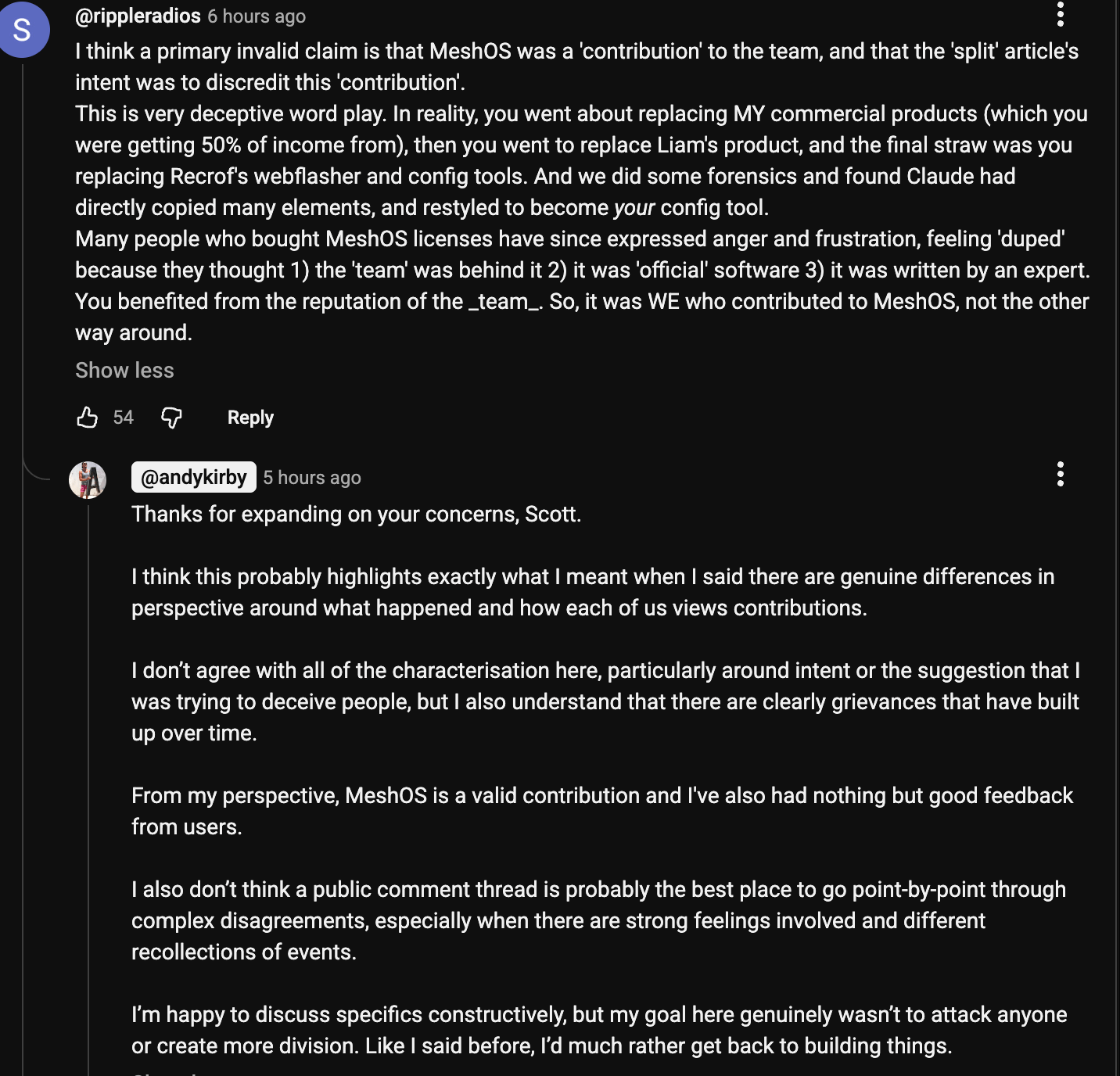
This exchange sits in the comments under Andy’s own video, which is itself his side of the story. We’re including it because it captures the disagreement in the operators’ own words. Andy’s reply (declining to litigate point-by-point in public) tracks the same posture he takes throughout the video.
The AI Question
Andy’s framing on the AI work: he has a software development background and uses AI as a tool to accelerate ideas and implementation. He describes “hyper moments” where he throws everything at a project for hours or days at a time. He’s open about the fact that AI is part of his workflow, and he pushes back on the framing that the AI involvement somehow invalidates the output.
His view is that the discussion became less about whether decisions were right or wrong and more about discrediting the work itself. He calls that personally difficult.
The core team’s earlier statement cited a Discord poll where a majority of respondents opposed undisclosed AI-generated firmware. That’s the gap. The dev team’s concern was disclosure. Andy’s frame is that disclosure became a wedge.
Where This Leaves Operators
Nothing about the firmware on your nodes today has changed since the split post in April. The same picture still holds:
Core team firmware ships from github.com/meshcore-dev/MeshCore. v1.15.0 remains the latest from that team.
MeshOS continues from Andy at meshcore.co.uk. Andy says he’s been pushing updates through this period despite the noise around the dispute.
The MeshCore app from Liam Cottle is unchanged. Third-party clients like MeshCore Open App remain independent of all of this.
If you flashed a node last month, it works the same today.
What We’re Watching
The trademark resolution. A filing isn’t a grant. Until that process completes, naming and branding stay contested.
MeshOS direction. Andy says he’s interested in building, not arguing. His update cadence over the next few months will say more than the video itself.
Whether dialogue resumes. Andy left the door open in his framing. The core team’s statement was firmer. Worth watching whether either side moves.
Community tone. Field operators tend to care more about whether their repeater is up than about who said what. The longer this stays in the headlines, the more that gap shows.
Two posts now. One from the core team, one from Andy. We’re keeping ours short on both sides because the value here is letting operators read the original sources and form their own view. If you’ve got questions about which firmware to run on which hardware, come ask on our Discord.
Comments
Related Posts
The MeshCore Split: What It Means for Operators
The MeshCore core team and Andy Kirby have separated. Here's what each side has said and where the practical picture stands for operators.
MeshCore vs Meshtastic: What Network Are You Building?
MeshCore floods once and learns a path. Meshtastic floods every hop. Pick by what you're trying to build, not which protocol wins.

Reading the MeshCore Disclosure From the Field
A heap overflow in MeshCore was fixed in v1.14.0 without an advisory. The exploit primitive, the impact tiers, and why disclosure still matters.