M5Stack Cardputer Mesh Kit: $48 Pocket Meshtastic Terminal
M5Stack's $48 Cardputer Mesh Kit ships pre-flashed with Meshtastic. ESP32-S3, SX1262, AT6668 GNSS, 56-key keyboard. Full specs and field notes.
M5Stack just shipped a card-sized standalone Meshtastic terminal for $48. The Cardputer Mesh Kit pairs the Cardputer-Adv (an ESP32-S3 hand-held with a 1.14” LCD and a 56-key keyboard) with a Cap LoRa-1262 module that combines a Semtech SX1262 radio with an AT6668 multi-constellation GNSS. It ships pre-flashed with Meshtastic. Product code M5-K152. Launched April 30, 2026.
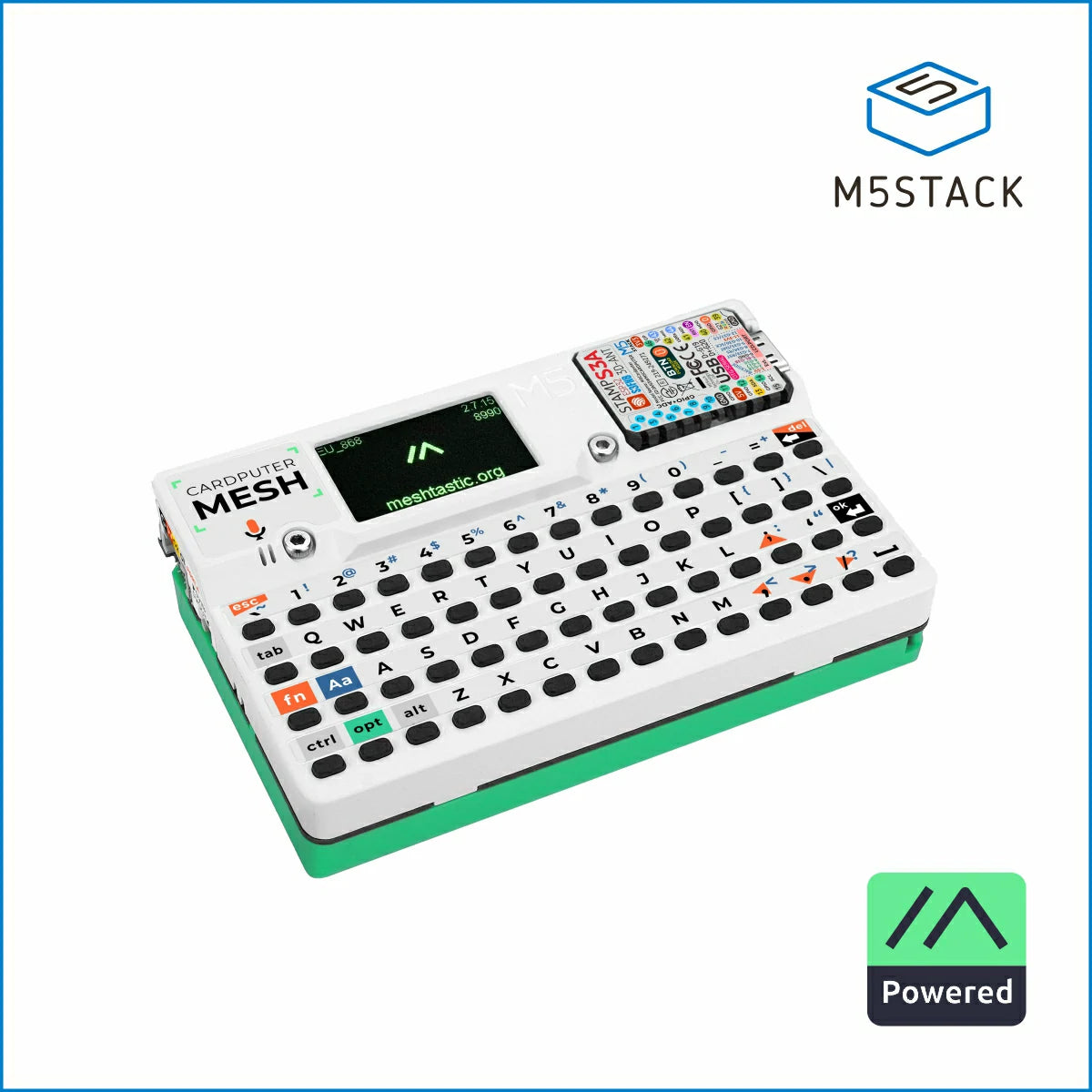
Up to now the cheapest way into Meshtastic has been a raw dev board plus a phone. The Cardputer Mesh Kit is the first sub-$50 device we’ve seen that you can take out of the box, install the antenna, set the region, and start sending messages without pairing anything. That’s a real shift in the entry-point story, and it matters more than another spec-sheet refresh.
We don’t have a Cardputer Mesh Kit in hand yet. Everything below comes from M5Stack’s product page, the M5Stack Meshtastic guide, and the CNX-Software preview. The comparison spec rows for the LILYGO T-Deck Plus come from LILYGO’s published specs. We haven’t run the two side-by-side, so any judgment about which one is better at a given job has to wait until we do.
What’s on the Card
At the core is the Cardputer-Adv, M5Stack’s updated take on the original Cardputer. It’s built around the ESP32-S3FN8 in a Stamp-S3A module. Same Wi-Fi, BLE 5, and USB-C dev experience as the rest of M5Stack’s S3 lineup, but packaged in a card-shaped chassis with the keyboard and display already in place.
The keyboard is the part that gets the most attention. 56 keys in a slim QWERTY layout, with the actuation force dropped from 260 gf on the original Cardputer to 160 gf on the Cardputer-Adv. That’s the kind of change you only make if real users typed on the first one and asked for less finger pressure. Whether 160 gf is enough to make sustained chat actually pleasant is something we’d want to test in hand.
The display is a 1.14” IPS LCD at 240 × 135. Not large. For one or two lines of message text and a status row, fine. For reading long-form content, you’ll be scrolling.
Around the keyboard and screen, M5Stack packed a 1750 mAh Li-ion battery, an ES8311 audio codec with a MEMS microphone, a 1 W speaker, a 3.5mm jack, a 6-axis BMI270 IMU, an IR emitter, a microSD slot, an HY2.0-4P Grove connector, and an EXT 2.54-14P expansion bus. The back has a magnetic mounting plate and LEGO-compatible mounting holes. It’s a kitchen-sink design pitched at beginners and hackers in equal measure.
The Cap LoRa-1262 Module
The Mesh Kit’s value comes from what M5Stack ships in the cap. The Cap LoRa-1262 is a snap-on module that turns the Cardputer-Adv from a hand-held microcontroller into a Meshtastic node. Inside is a Semtech SX1262 running on 868 to 923 MHz with a published max TX power of +22 dBm and receive sensitivity down to -147 dBm. RF shielding around the radio. RP-SMA connector for the antenna.
Co-located with the radio is an ATGM336H-6N (AT6668) multi-constellation GNSS receiver supporting six constellations: GPS, QZSS, BeiDou (BD2 + BD3), Galileo, and GLONASS. Built-in positioning is rare at this price point.
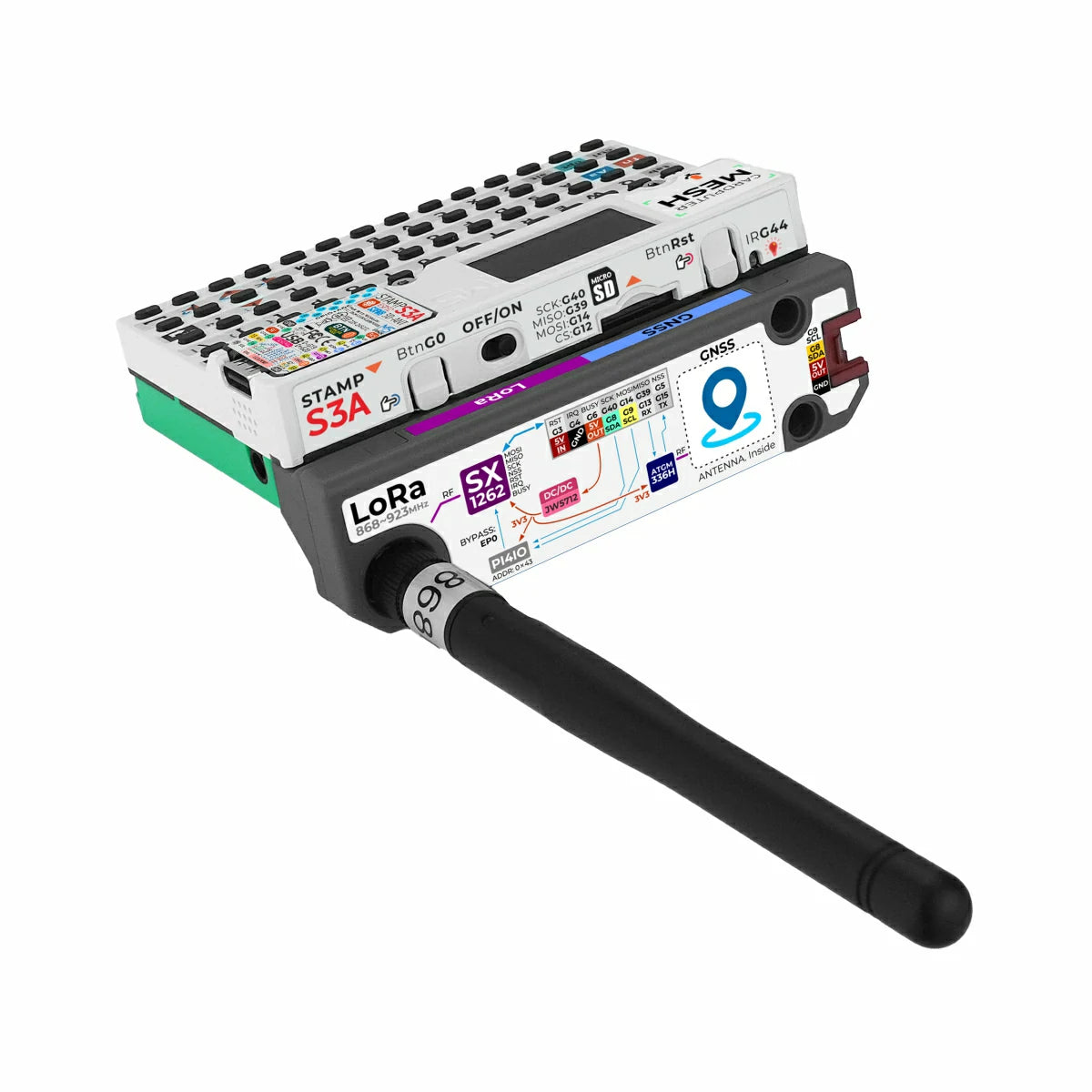
A note pulled directly from M5Stack’s documentation: never connect or power on the device without the antenna installed. Transmitting into an unloaded RF output can damage the SX1262’s PA. This is true of any LoRa board, not specific to the Cardputer Mesh Kit, but worth restating.
Software Story
The kit ships pre-flashed with Meshtastic. For a first-time user, that means the first power-on goes straight to the device’s setup flow, not a firmware install.
If you do need to reflash or update, M5Stack documents the workflow through their own M5Burner tool with a 1500000-baud download mode. The device is also reachable through the Meshtastic Web Flasher for browser-based updates, which is the path most newcomers will land on first.
US users will need to set the regional preset to 915 MHz in the Meshtastic app on first run. M5Stack’s docs note this generically as “set the region according to your hardware,” so first-time users should know to make the change rather than leave the default in place.
For upgraders who already own a Cardputer-Adv, the Cap LoRa-1262 module sells separately for $14.50, turning the existing handheld into a Meshtastic node without buying the full kit.
Full Specs
| Spec | Detail |
|---|---|
| Base device | M5Stack Cardputer-Adv |
| MCU | ESP32-S3FN8 (Stamp-S3A module) |
| Display | 1.14” IPS LCD (240 × 135), ST7789V2 |
| Keyboard | 56 keys (4 × 14), 160 gf actuation force |
| LoRa Chip | Semtech SX1262 (Cap LoRa-1262 module) |
| Frequency | 868 to 923 MHz |
| Max TX Power | +22 dBm |
| Rx Sensitivity | -147 dBm (low data rate mode) |
| LoRa Antenna | External, RP-SMA female |
| GNSS | ATGM336H-6N (AT6668), 6 constellations: GPS, QZSS, BD2, BD3, GAL, GLO |
| Battery | 1750 mAh Li-ion |
| Audio | ES8311 codec, MEMS mic, 1 W speaker, 3.5mm jack |
| IMU | BMI270 (6-axis) |
| IR | Emitter |
| Storage | microSD slot |
| Connectivity | HY2.0-4P Grove, EXT 2.54-14P bus |
| USB | USB-C |
| Wireless | Wi-Fi, BLE 5 (via ESP32-S3) |
| Mounting | Magnetic backing, LEGO-compatible holes |
| Firmware (out of box) | Meshtastic |
| Flashing | M5Burner, Meshtastic Web Flasher |
| Product code | M5-K152 |
| Price | $48 |
How It Compares to the LILYGO T-Deck Plus
The closest analog in the same price band is the LILYGO T-Deck Plus. Both are pocketable Meshtastic terminals with QWERTY input and built-in GNSS. Both run pre-flashed firmware out of the box. The design tradeoffs are where they diverge.
| M5Stack Cardputer Mesh Kit | LILYGO T-Deck Plus | |
|---|---|---|
| MCU | ESP32-S3FN8 (8 MB flash) | ESP32-S3FN16R8 (16 MB flash, 8 MB PSRAM) |
| Display | 1.14” IPS LCD (240 × 135) | 2.8” IPS LCD (320 × 240) |
| Keyboard | 56 keys (4 × 14), 160 gf actuation | QWERTY thumb keyboard |
| LoRa Chip | SX1262 | SX1262 |
| Max TX Power | +22 dBm | +22 dBm |
| GNSS | AT6668, 6 constellations | GPS (L76K or Ublox by SKU) |
| Battery | 1750 mAh | 2000 mAh |
| Audio out | 1 W speaker, 3.5mm | Speaker, 3.5mm |
| Form factor | Card (pocketable) | Slab (jacket pocket) |
| Firmware out of box | Meshtastic | Meshtastic |
| Price | $48 | $70.99 (varies by region/SKU) |
On paper, the Cardputer comes in cheaper, smaller, and with more constellations on the GNSS receiver. The T-Deck Plus has a larger display, more memory headroom (16 MB flash plus 8 MB PSRAM versus the Cardputer’s 8 MB flash), and a bigger battery. The practical question (does the Cardputer’s flat 56-key board hold up for actual chat sessions, or does the T-Deck Plus’s thumb keyboard earn the price premium?) is one we’d want to test before calling it.
GNSS is the clearest published difference. The Cardputer’s AT6668 lists six constellations versus the T-Deck Plus’s GPS-only setup with an L76K or Ublox option depending on SKU. Lock time and accuracy under tree cover are again something we’d want to measure rather than assume.
On paper, the Cardputer is the smallest pocketable Meshtastic terminal at the lowest entry price. The T-Deck Plus puts more screen and more memory in front of you for around 50 percent more money. We haven’t run them head-to-head. When we do, we’ll report back.
What We’re Watching
A few things stand out as the parts of this kit that the spec sheet alone won’t answer.
Keyboard ergonomics for sustained chat. 160 gf actuation is a real improvement over 260 gf. Whether the layout, key spacing, and tactile feedback hold up for replies longer than a sentence is the actual usability test. This is the single biggest “does it work as a terminal” question.
Range at 22 dBm vs higher-power boards. +22 dBm is in the same range as the unamplified Heltec V3 and most beginner boards. It’s not in the same league as the 28 dBm amplified boards or the 1 W RAK WisMesh nodes. For a pocket terminal that will mostly hop through repeaters, that’s fine. For an isolated direct shot across a few miles, less so.
Battery life with display and GNSS active. The 1750 mAh figure is generous for a card-sized device. Real runtime depends on display brightness, GPS poll interval, LoRa duty cycle, and how often the speaker is in use. We’d want to log a typical day of use rather than trust the number.
GNSS lock time and accuracy. Six-constellation support is solid in spec terms. The onboard antenna geometry inside a card-sized chassis is the variable. AT6668 implementations vary widely in cold-start time depending on board layout, and the Cap LoRa-1262’s antenna placement next to the radio shielding is worth checking under tree cover.
First-flash experience via the Web Flasher. US users in particular need to land on the 915 MHz regional preset. M5Stack’s pre-flash should handle the firmware side, but we want to see how cleanly the region setting is communicated to a first-time user who’s never opened the Meshtastic app before.
Who This Is For
M5Stack is pitching this at first-time users and at anyone who wants a pocketable standalone Meshtastic terminal without a phone in the loop. On paper, that fits. Pre-flashed firmware, an integrated keyboard, GNSS, and a battery in one card-sized package is a lower-friction starting point than a raw dev board. Whether the keyboard and 1.14” display hold up for sustained chat is something we’d want to verify in hand.
If you mostly read messages and rarely send long replies, a pager-style device like the LILYGO T-LoRa Pager is cheaper still. If you’re building a tracker more than a chat terminal, look at the SenseCAP T1000-E. If you’re after 1 W output for a solar repeater, the Cardputer’s 22 dBm radio isn’t the right tool. Look at the higher-power boards instead.
For someone walking into Meshtastic for the first time and asking “what should I buy that just works,” the Cardputer Mesh Kit is a credible answer and the price is good. We’re recommending Meshtastic as the on-ramp for newcomers anyway, and a $48 device that ships ready-to-mesh fits that recommendation cleanly.
We’ll get one on the bench and report back. Until then, the spec sheet tells one story. Field performance will tell another.
You can find the Cardputer Mesh Kit on M5Stack’s product page or through M5Stack’s AliExpress listings.
Product photos courtesy M5Stack.
Comments
Related Posts
RAK WisMesh Pocket V3: IP67 Meshtastic Handheld for $84.97
The WisMesh Pocket V3 adds an IP67 molded case, better GPS and a buzzer for $84.97. Specs, what changed from the V2, MeshCore status and ship dates.
RAK WisMesh Station HP: First Look at a Pi 4 Mesh Node
RAK's WisMesh Station HP puts a Raspberry Pi 4, a WisBlock HAT, and a 1-watt-class SX1262 in a finned aluminum case. Hardware tour and what it runs.
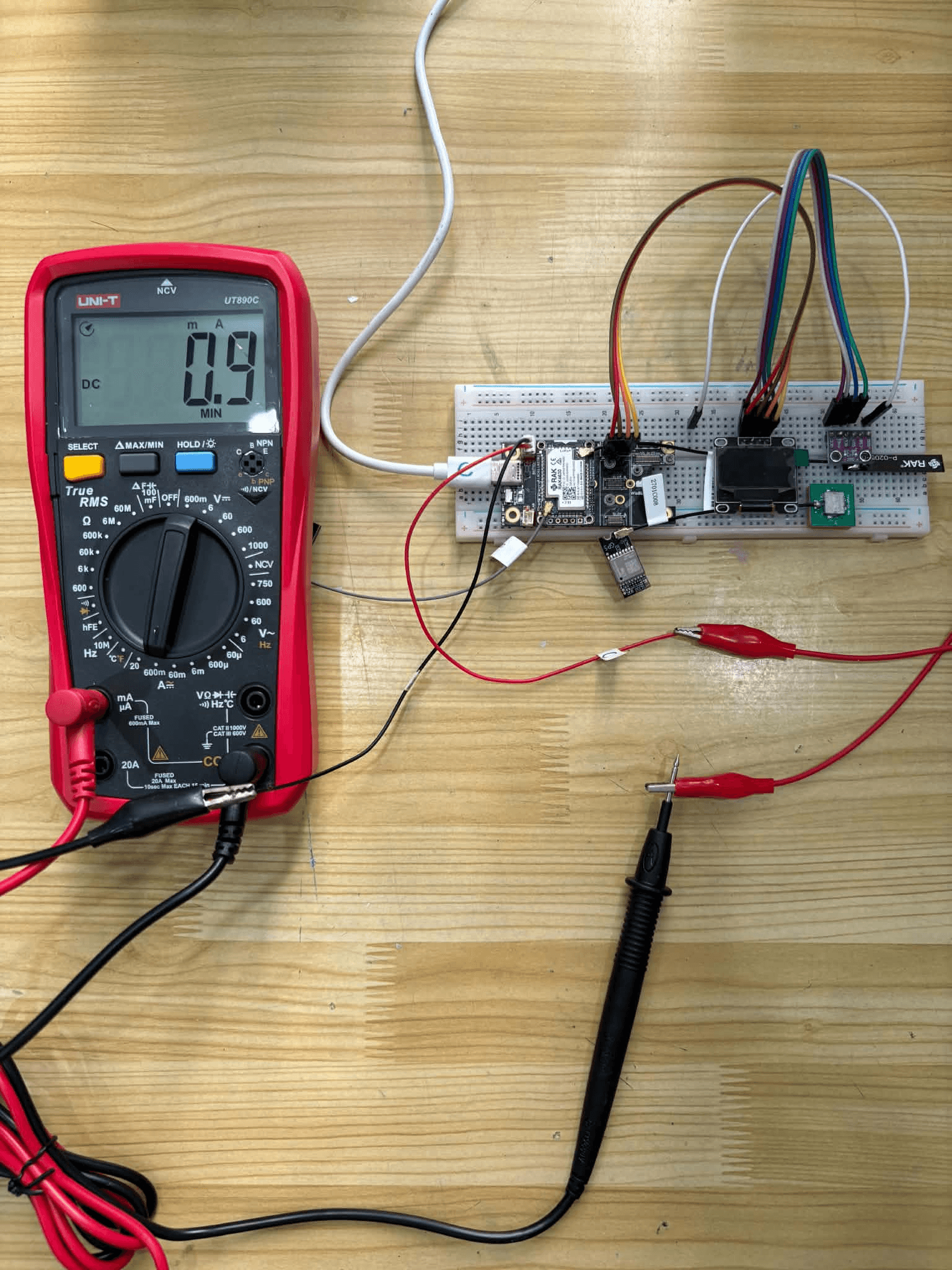
EasySkyMesh PowerSaving 17: RX Sleep Down to 0.9 mA
EasySkyMesh PowerSaving 17 adds RX duty-cycle sleep, pushing RAK4631 repeaters to 0.9 mA. Built on MeshCore 1.16, plus a GPS powersaving catch-up.