Heltec Mesh Node T096: nRF52840, Boosted LoRa, GPS for $30
The Heltec T096 pairs an nRF52840 with an amplified SX1262 pushing 28 dBm, dual-band GPS, color TFT, and solar charging. Full specs and V4 comparison.
Heltec just listed a new board that caught our attention. The Mesh Node T096 is a compact LoRa development board built around the Nordic nRF52840, with an amplified SX1262 radio, dual-band GPS, a color TFT display, and a solar charging connector. It runs Meshtastic and MeshCore out of the box. Priced at $29.90.
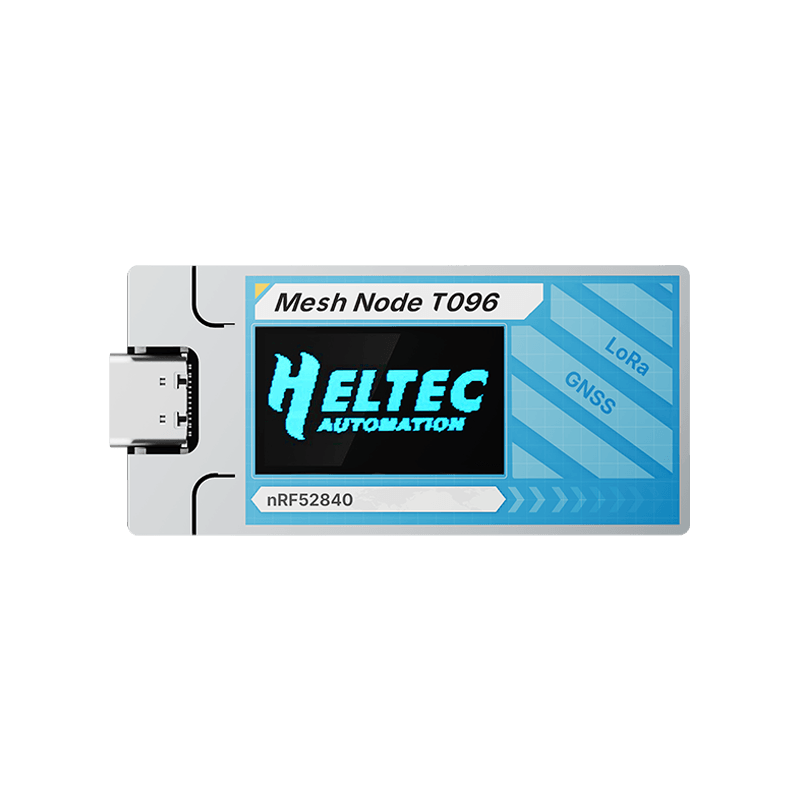
If you’ve been following Heltec’s lineup, you know them from the WiFi LoRa 32 series. The V3 has been one of the most popular boards in the mesh community, and the newer V4 brought amplified LoRa (also 28 dBm) to the ESP32 platform. The T096 takes a different direction entirely. It swaps the ESP32 for an nRF MCU, drops Wi-Fi, and adds onboard GPS and a color TFT. Same amplified radio philosophy as the V4, but built for a completely different use case.
We don’t have one in hand yet. Everything here comes directly from Heltec’s published specifications. No guesswork, no assumptions.
What’s on the Board
At the core is the nRF52840 from Nordic Semiconductor. It’s the same MCU you’ll find in RAK WisBlock nodes and a bunch of other mesh-friendly hardware. It supports Bluetooth 5 and Bluetooth Mesh, has plenty of GPIO (SPI, I2C, UART, PWM, QSPI), and is well supported by both Meshtastic and MeshCore firmware.
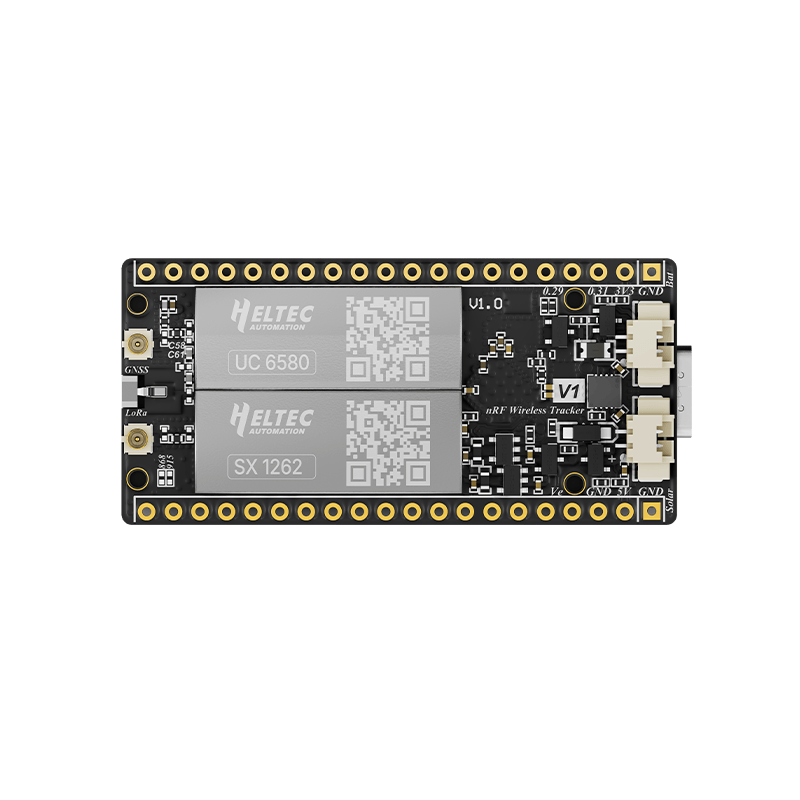
The LoRa radio is a Semtech SX1262 with an integrated power amplifier. Heltec lists the max TX power at 28 dBm (plus or minus 1 dB). That’s roughly 630 mW. If you’re coming from an unamplified board like the V3 at 21 dBm (about 125 mW), that’s around 5x the output power. The V4 also pushes 28 dBm with its own PA, so this isn’t new territory for Heltec. They’ve clearly committed to amplified LoRa across their product line. The T096 also has an LNA (low noise amplifier) that can be bypassed. The specific PA and LNA chip models aren’t published on the product page.
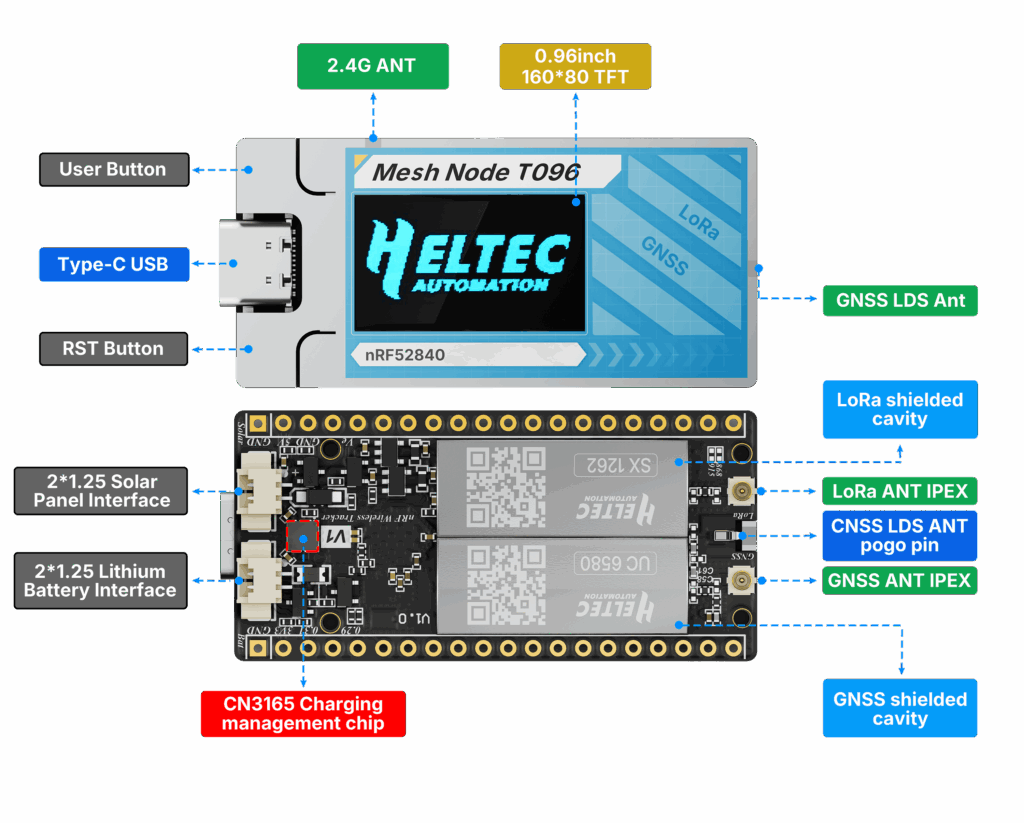
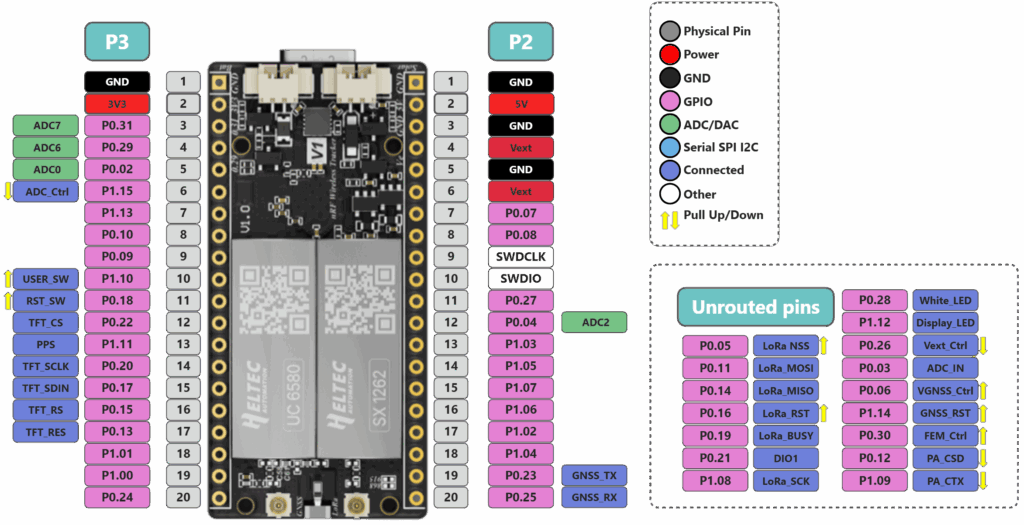
For positioning, there’s a UC6580 GNSS chip supporting dual-band L1 and L5 frequencies across six constellations: GPS, GLONASS, BeiDou, Galileo, NAVIC, and QZSS. The GNSS and Bluetooth antennas are built into the PCB using Laser Direct Structuring (LDS), which keeps the board compact. If the onboard GNSS antenna doesn’t cut it for your environment, there’s an IPEX connector for an external one (requires moving a resistor to switch over). Heltec notes that the GNSS works best outdoors or with an external antenna.
The front of the board features a 0.96-inch 160x80 color TFT display under the protective cover. It’s not an OLED like the V3/V4 uses. A color TFT at this resolution gives you enough to display node status, GPS coordinates, and signal info without needing to pull out your phone.
LoRa uses an external antenna through an IPEX 1.0 connector. The kit ships with a LoRa antenna, an SMA-to-IPEX adapter, battery connector cable, and pin headers.
Power and Charging
This is where the nRF platform really shows its hand. Heltec quotes a sleep current of 12 uA and a Bluetooth operating current of just 2 to 10 mA. For context, ESP32-based boards draw significantly more in sleep and active BLE modes. That matters a lot for solar-powered nodes or anything running on a battery for extended periods.
The board has a 1.25mm 2-pin lithium battery connector and a dedicated 1.25mm 2-pin solar panel connector. The battery management system handles charge and discharge, overcharge protection, battery level detection, and automatic switching between USB and battery power. You can power it via USB-C at 5V or from a 3.7V lithium battery (3.3 to 4.2V range).
Having the solar connector built in matters. A lot of boards need you to splice wires or add a charge controller. This one has it on the PCB.
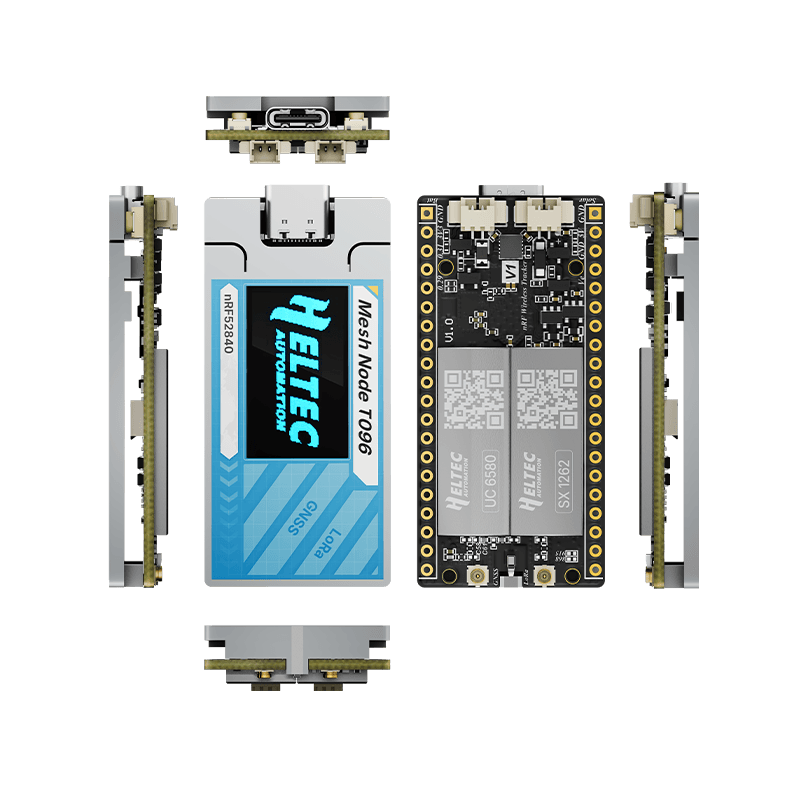
Full Specs
| Spec | Detail |
|---|---|
| MCU | nRF52840 |
| LoRa Chip | SX1262 (with integrated PA) |
| GNSS Chip | UC6580 (L1 + L5) |
| Frequency | 863 to 928 MHz |
| Max TX Power | 28 dBm (+/- 1 dB) |
| Bluetooth | BLE 5, Bluetooth Mesh |
| Display | 0.96” TFT color (160x80) |
| USB | Type-C (USB 2.0) |
| Battery | 1.25-2P lithium battery connector |
| Solar | 1.25-2P solar panel connector |
| LoRa Antenna | External, IPEX 1.0 |
| GNSS Antenna | LDS onboard (external via IPEX optional) |
| BT Antenna | LDS onboard |
| GPIO | 2x13 2.54mm header pins |
| Peripherals | 4x SPI, 2x I2C, 2x UART, 4x PWM, QSPI, I2S, PDM, QDEC |
| LEDs | 2 |
| Buttons | 2 |
| Operating Temp | -20 to 70 C |
| Dimensions | 52.0 x 25.4 x 10.3 mm |
| Firmware | Meshtastic, MeshCore, LoRaWAN |
| Price | $29.90 |
How It Compares to the Heltec V4
The most natural comparison here is the WiFi LoRa 32 V4. Both boards push 28 dBm through an amplified SX1262, both support Meshtastic and MeshCore, and both have solar charging. But the platform underneath is fundamentally different.
| T096 | WiFi LoRa 32 V4 | |
|---|---|---|
| MCU | nRF52840 | ESP32-S3R2 |
| LoRa Chip | SX1262 (with PA) | SX1262 (with PA) |
| TX Power | 28 dBm | 28 dBm |
| Wi-Fi | No | 802.11 b/g/n |
| Bluetooth | BLE 5, Bluetooth Mesh | BLE 5, Bluetooth Mesh |
| GPS | Onboard UC6580 (L1+L5, 6 constellations) | 8-pin GNSS interface (module not included) |
| Display | 0.96” TFT color (160x80) | 0.96” OLED (optional) |
| Solar Connector | Yes | Yes |
| Sleep Current | 12 uA | Less than 20 uA |
| Memory | Not published | 512KB SRAM, 2MB PSRAM, 16MB Flash |
| GPIO Pins | 2x13 header | 40-pin header |
| Dimensions | 52.0 x 25.4 x 10.3 mm | 51.7 x 25.4 x 10.7 mm |
| Price | $29.90 | $17.90 to $19.90 |
The RF output is the same. Both boards hit 28 dBm. The differences are everything around the radio.
The V4 keeps the ESP32 ecosystem: Wi-Fi for web-based configuration, an OLED display, more memory, and a lower price. It also has a GNSS interface header, but the GPS module isn’t onboard. You’d need to add one externally. It’s the natural upgrade from the V3 if you want more transmit power without changing platforms.
The T096 trades all of that for the nRF52840’s power efficiency. A 12 uA sleep current versus the V4’s sub-20 uA might not sound like much on paper, but the nRF’s lower active-mode draw is where the real gap opens up, especially during BLE operations (2 to 10 mA on the T096). For a node that wakes up, transmits, and goes back to sleep hundreds of times a day, those milliamps add up fast. The T096 also has GPS built right into the board, not as an add-on. Six constellations, dual-band L1/L5, ready to go.
If you’re building a base station or a desktop node where power isn’t a concern, the V4 gives you more features for less money. If you’re deploying a solar repeater on a hilltop, a tracker in a vehicle, or a portable node in a go-bag, the T096’s power profile and built-in GPS make it the more practical choice.
What We’re Watching
A few things stand out that we’ll want to verify once we can test one hands-on:
Actual RF performance at 28 dBm. The spec says 28 dBm with a PA, but how clean is the output? Does the amplifier introduce noise? How does the receive sensitivity hold up at full power? The bypassable LNA suggests Heltec thought about this, but the proof is in the testing.
GPS lock time and accuracy. The UC6580 with dual-band L1/L5 should be solid on paper. Six-constellation support is thorough. But onboard LDS GNSS antennas can be hit or miss depending on the board layout and ground plane. The option for an external antenna is good to see.
Battery life in practice. The 12 uA sleep figure is promising, and nRF boards generally deliver on low-power claims. But real-world consumption depends on how often the radio wakes, GPS polling intervals, and firmware configuration. We’d want to measure actual draw across different Meshtastic and MeshCore configurations.
Thermal behavior. Pushing 28 dBm from a board this small could generate some heat during sustained transmission. Worth monitoring in enclosed cases or during summer deployments.
Case and mounting options. At 52 x 25.4 mm, it’s nearly identical in footprint to the V3 and V4. Hopefully that means existing case designs will adapt without too much rework.
Who This Board Is For
If you’re building solar-powered relay nodes, remote repeaters, or portable field kits where battery life and range are the priority, the T096 looks like it fills a gap in Heltec’s lineup. An amplified nRF board with GPS and solar charging at $30 is competitive with what’s out there from other manufacturers, and Heltec has a track record of keeping their boards well supported in Meshtastic firmware.
It’s not a replacement for the V4. It’s a complement. Different tool for a different job.
We’re looking forward to getting our hands on one and putting it through its paces on our network. Until then, these specs tell a compelling story. Heltec is clearly paying attention to what the mesh community has been asking for: more power, lower consumption, built-in GPS, and solar-ready out of the box.
You can find the Mesh Node T096 on Heltec’s product page.
Comments
Related Posts
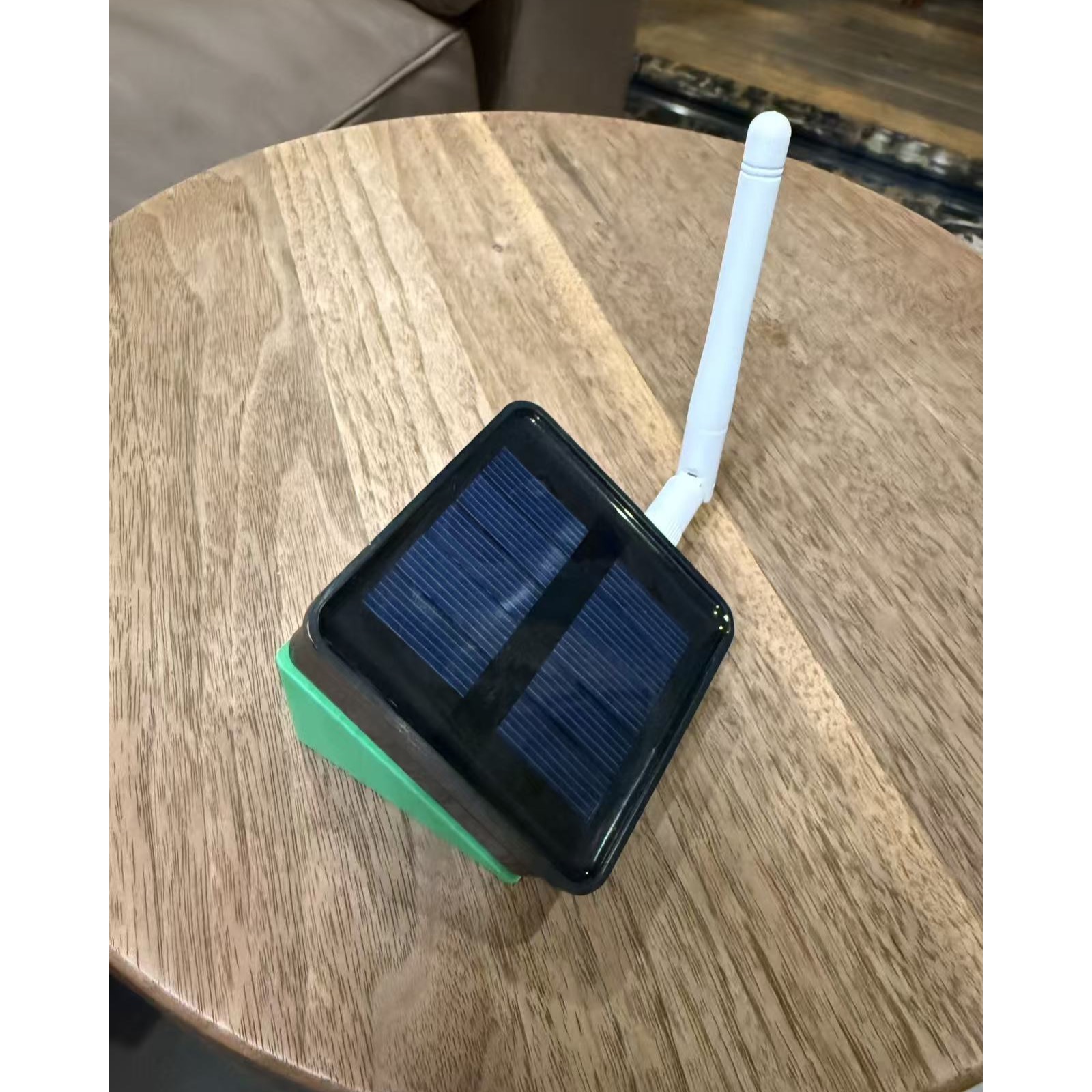
GAT562 30s Mesh Solar Repeater: 1W nRF52840 for $39.99
GAT562 30s pairs an nRF52840 with a 1W LoRa stage and direct solar pads for $39.99. Specs, the no-MPPT story, and RAK WisMesh 1W comparison.
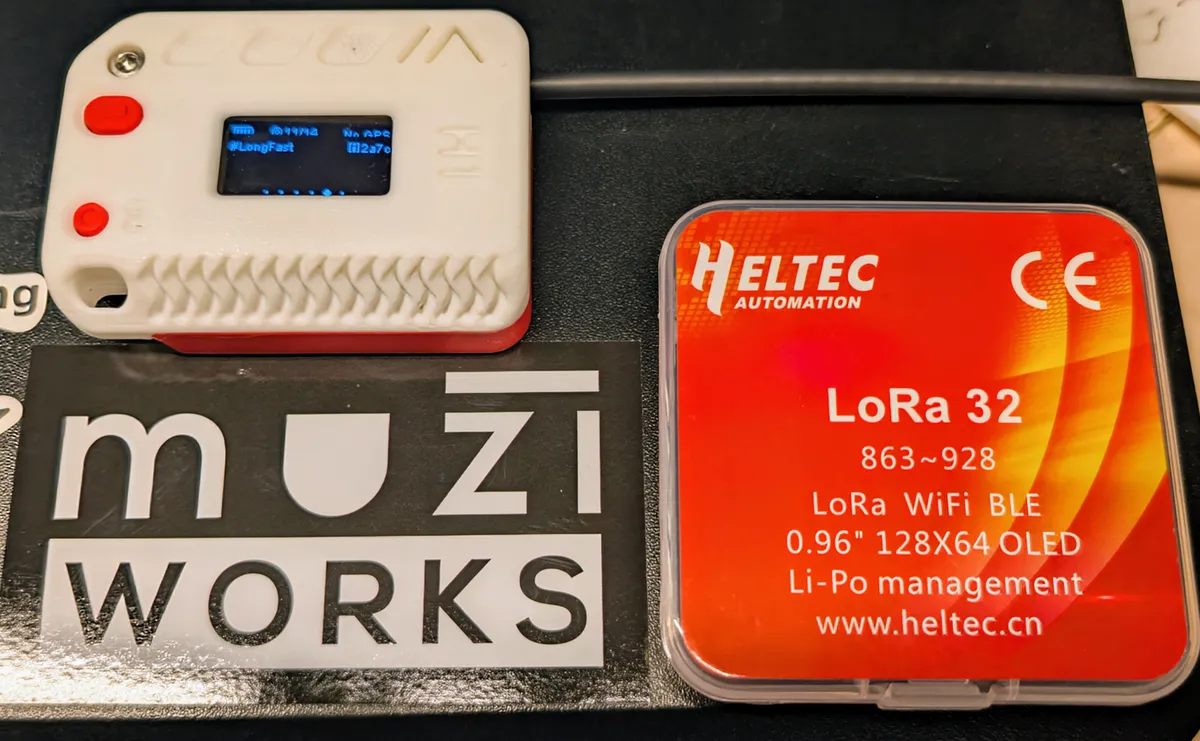
Heltec WiFi LoRa 32 V3 Review: The Default Mesh Board
Field review of the Heltec V3 for Meshtastic and MeshCore. ESP32-S3, SX1262, OLED, USB-C. Why it's still our default recommendation.
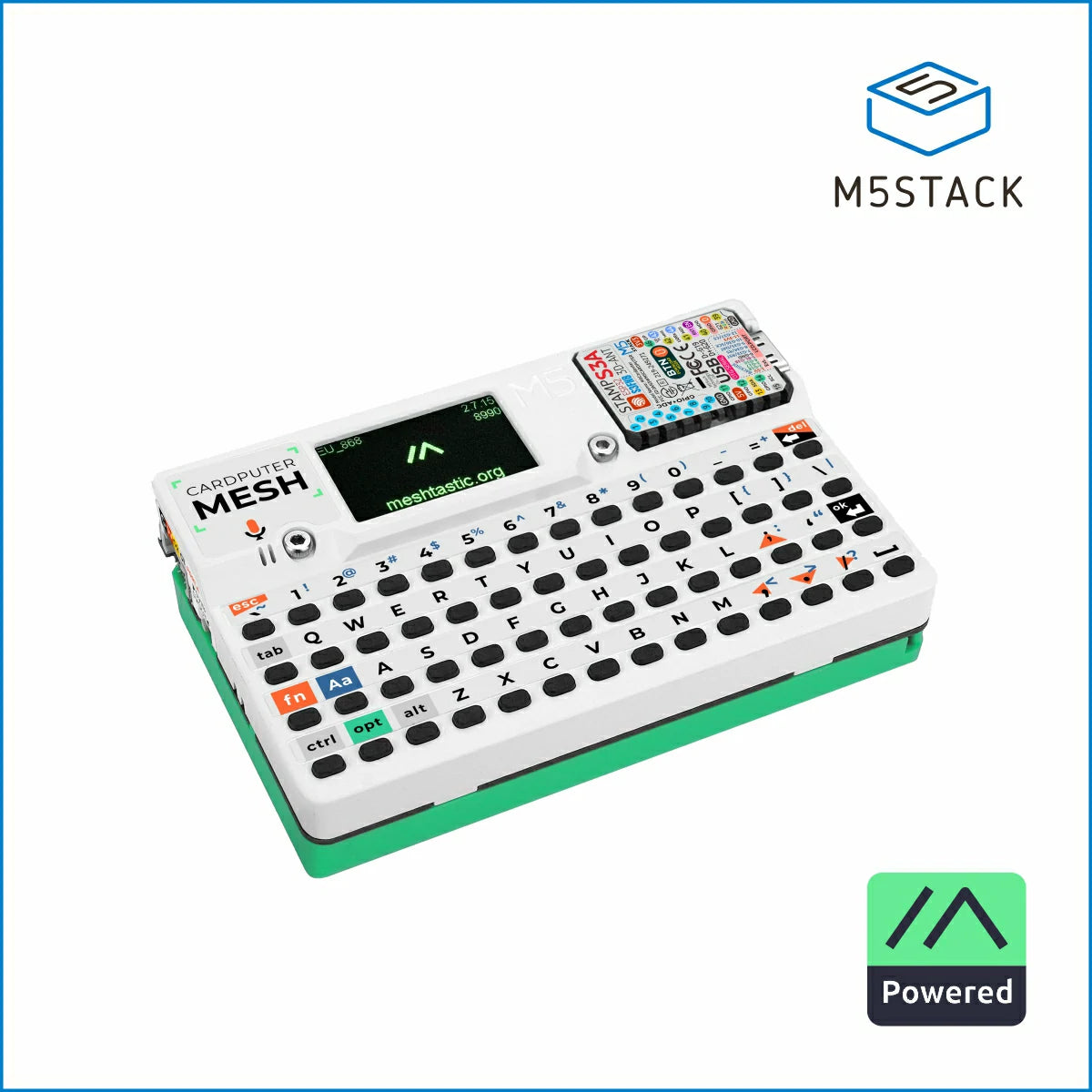
M5Stack Cardputer Mesh Kit: $48 Pocket Meshtastic Terminal
M5Stack's $48 Cardputer Mesh Kit ships pre-flashed with Meshtastic. ESP32-S3, SX1262, AT6668 GNSS, 56-key keyboard. Full specs and field notes.