FCC Part 15.247: The 500 kHz Minimum and LoRa Mesh
Part 15.247 sets a 500 kHz minimum 6 dB bandwidth for digital modulation at 900 MHz. What the rule says, and where Meshtastic and MeshCore presets land.
500 kHz is the number, and almost nothing in LoRa mesh is running it.
47 CFR 15.247(a)(2) sets a minimum 6 dB bandwidth of 500 kHz for digitally modulated systems in the 902 to 928 MHz band. Meshtastic’s default Long Fast preset is 250 kHz. MeshCore’s USA preset is 62.5 kHz. Neither one hops. That gap is what the mesh community has spent the better part of a year arguing about, and in the last few weeks it has started to change what people actually run.
We are not lawyers and this is not legal advice. This post does the thing we can actually do: read the rule text, the FCC’s own measurement guidance, and the public engineering record, then lay out what they say and what is still contested. It does not tell you what to run, it does not tell you whether any given configuration is lawful, and it makes no recommendation. Those are determinations for a qualified professional, and ultimately for the Commission.
What the Rule Actually Says
Section 15.247 opens by naming what it covers: “Operation under the provisions of this Section is limited to frequency hopping and digitally modulated intentional radiators that comply with the following provisions.” Two categories, each with its own paragraph. Frequency hopping systems get 15.247(a)(1). Digital modulation gets 15.247(a)(2), and the operative part is one sentence long: “Systems using digital modulation techniques may operate in the 902-928 MHz, 2400-2483.5 MHz, and 5725-5850 MHz bands. The minimum 6 dB bandwidth shall be at least 500 kHz.”
The rest of the section supplies the other limits that apply to a digitally modulated system in this band:
| Parameter | Limit | Cite |
|---|---|---|
| Minimum 6 dB bandwidth | 500 kHz | 15.247(a)(2) |
| Max peak conducted output power | 1 W | 15.247(b)(3) |
| Power spectral density | 8 dBm in any 3 kHz band | 15.247(e) |
| Out-of-band emissions | At least 20 dB below the highest in-band 100 kHz | 15.247(d) |
| Directional antenna gain | Above 6 dBi, reduce power by the excess | 15.247(b)(4) |
That antenna line is worth reading slowly. The power limit is conducted, measured at the antenna port, and the rule only starts clawing power back once a directional antenna exceeds 6 dBi of gain. It is not a flat EIRP cap.
What “6 dB Bandwidth” Means
The 6 dB bandwidth is the frequency span between the points where the signal has fallen 6 decibels below its peak. It is a specific measurement with a specific procedure, defined for these devices in ANSI C63.10 and in the FCC’s measurement guidance document KDB 558074, which restates the limit in the same terms and gives it a name: “The minimum 6 dB bandwidth of a DTS transmission shall be at least 500 kHz. Within this document, for DTS devices this bandwidth is referred to as the DTS bandwidth.”
For LoRa the practical answer is unsurprising. A chirp spread spectrum signal occupies close to its configured bandwidth, so a 125 kHz LoRa transmission measures near 125 kHz at the 6 dB points, and a 500 kHz transmission measures near 500 kHz. Spreading factor changes how long the symbol takes, not how wide it is. That is why no amount of SF11 or SF12 turns a 250 kHz signal into a 500 kHz one.
One easy confusion to avoid: the hopping rules in 15.247(a)(1) are written against the 20 dB bandwidth, not the 6 dB bandwidth. Different threshold, different number, different paragraph.
Four Doors Into the Band
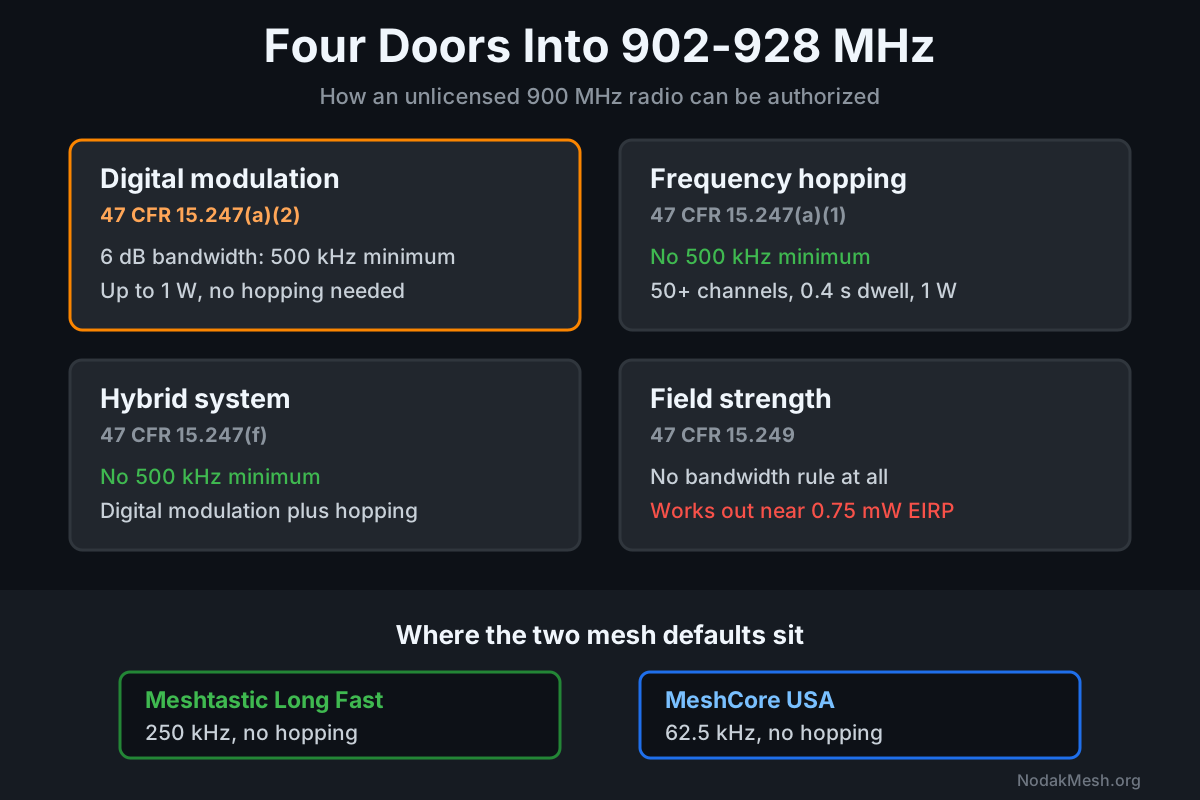
Digital modulation is one way to be authorized here, not the only one. A compliance test lab’s guide to LoRa certification describes three paths under the Part 15 rules, and a fourth exists outside 15.247 entirely.
| Path | Cite | Bandwidth demand | Power ceiling |
|---|---|---|---|
| Digital modulation (DTS) | 15.247(a)(2) | 6 dB bandwidth at least 500 kHz | 1 W |
| Frequency hopping (FHSS) | 15.247(a)(1) | No 500 kHz minimum | 1 W with 50+ channels, 0.25 W with 25 to 49 |
| Hybrid | 15.247(f) | No 500 kHz minimum | PSD of 8 dBm per 3 kHz with hopping off |
| Field strength | 15.249 | No bandwidth rule | 50 mV/m at 3 m |
The hopping path is how a 125 kHz LoRa signal becomes ordinary. LoRaWAN in the US hops 125 kHz channels across the band, meeting 15.247(a)(1) instead of (a)(2), which is why The Things Network running 125 kHz uplinks is not evidence that narrow fixed-channel operation is fine. Different paragraph, different rules.
The hybrid path is explicit on the point. KDB 558074, on hybrid systems: “There is no requirement for this type of hybrid system to comply with the 500 kHz minimum bandwidth normally associated with a DTS device.” The same guidance adds that a hybrid has no minimum channel count, though the hop sequence still has to be pseudorandom under 15.247(a)(1).
The fourth door is 15.249, which does not regulate conducted power at all. It caps field strength at 50 mV/m measured at 3 meters. Converting that to an equivalent radiated power, using EIRP equal to the square of field strength times distance, divided by 30, gives about 750 microwatts. Under a milliwatt. Whatever else that path is, it is not where a mesh node with a 22 dBm radio lives.
The Second Limit Nobody Mentions
The 500 kHz minimum gets the attention. The power spectral density limit in 15.247(e) is the one that quietly does the arithmetic. The power “conducted from the intentional radiator to the antenna shall not be greater than 8 dBm in any 3 kHz band during any time interval of continuous transmission.”
Power spread over a narrower signal is denser. Take a fixed 8 dBm ceiling per 3 kHz slice, and the total power a signal of a given width can carry falls as the signal narrows.
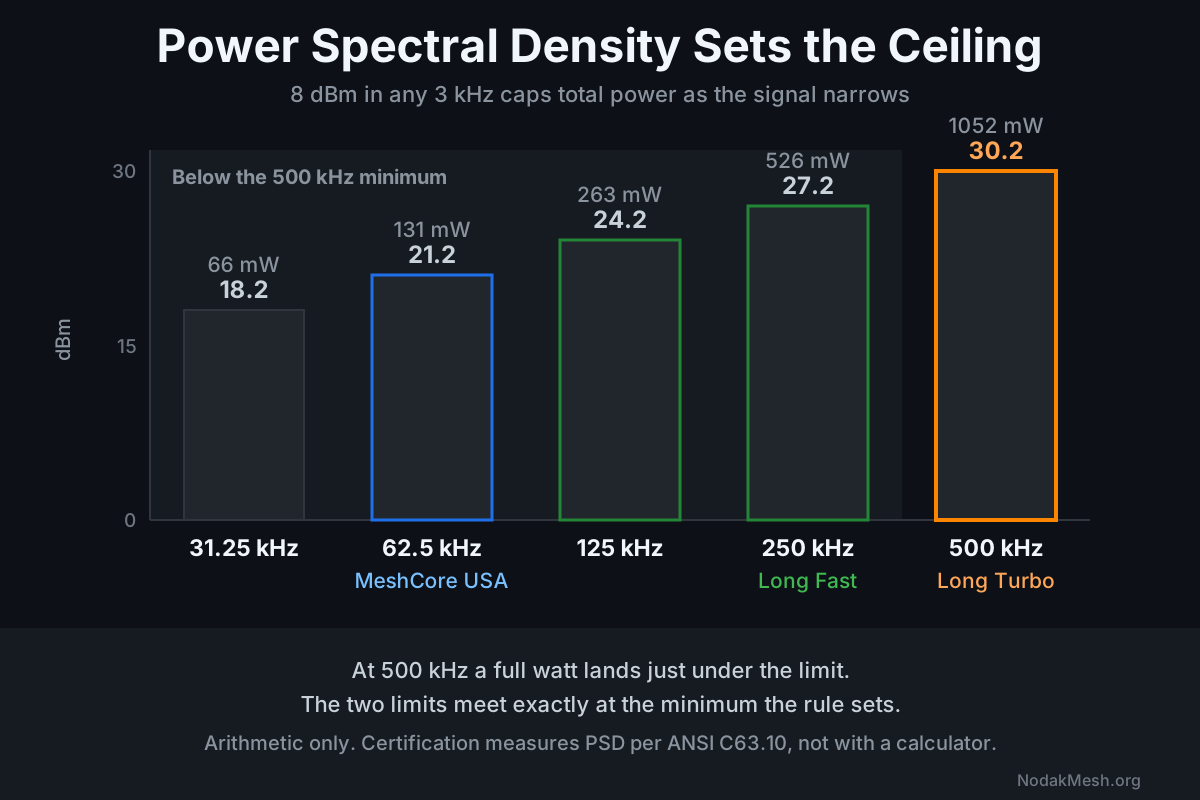
| Bandwidth | PSD-implied power ceiling |
|---|---|
| 31.25 kHz | 18.2 dBm (66 mW) |
| 62.5 kHz | 21.2 dBm (131 mW) |
| 125 kHz | 24.2 dBm (263 mW) |
| 250 kHz | 27.2 dBm (526 mW) |
| 500 kHz | 30.2 dBm (1052 mW) |
Notice where that lands. At 500 kHz the density limit permits just over a watt, and the separate conducted power limit is exactly one watt. The two limits meet at the bandwidth the rule sets as the minimum. The rule set is internally consistent, which is a decent clue that the 500 kHz figure was chosen deliberately rather than arbitrarily.
That table is arithmetic, not a test report. Certification measures PSD with a spectrum analyzer under ANSI C63.10 procedures with specified resolution bandwidth and detectors, and a real LoRa chirp does not deposit energy perfectly evenly. Treat the numbers as the shape of the constraint rather than as a compliance result.
It does explain a pattern visible in public grant data, though. High-power 900 MHz LoRa modules frequently carry authorized conducted power well below what their hardware can produce. The Skyworks-boosted RAK13302 is a nominal 30 dBm part, and its grants under FCC ID 2AF6B-13302 authorize 0.2897 W as a spread spectrum transmitter and 0.2831 W as a digital transmission system, both figures peak conducted. Under 290 mW either way, against hardware rated for more than three times that.
Where the Presets Land
Meshtastic’s published modem presets:
| Preset | Bandwidth | SF | Coding rate | Data rate |
|---|---|---|---|---|
| Short Turbo | 500 kHz | 7 | 4/5 | 21.88 kbps |
| Short Fast | 250 kHz | 7 | 4/5 | 10.94 kbps |
| Short Slow | 250 kHz | 8 | 4/5 | 6.25 kbps |
| Medium Fast | 250 kHz | 9 | 4/5 | 3.52 kbps |
| Medium Slow | 250 kHz | 10 | 4/5 | 1.95 kbps |
| Long Turbo | 500 kHz | 11 | 4/8 | 1.34 kbps |
| Long Fast (default) | 250 kHz | 11 | 4/5 | 1.07 kbps |
| Long Moderate | 125 kHz | 11 | 4/8 | 0.34 kbps |
| Long Slow | 125 kHz | 12 | 4/8 | 0.18 kbps |
Two of nine are 500 kHz. The default is not one of them.
MeshCore distributes its suggested settings through a configuration service its clients read, currently carrying 27 regional presets. The US-relevant entries:
| Preset | Frequency | SF | Bandwidth | Coding rate |
|---|---|---|---|---|
| USA | 910.525 MHz | 7 | 62.5 kHz | 4/5 |
| Canada | 910.525 MHz | 7 | 62.5 kHz | 4/5 |
| USA - Southern California | 927.875 MHz | 7 | 62.5 kHz | 4/5 |
| USA - Philadelphia (PhillyMesh) | 902.250 MHz | 11 | 500 kHz | 4/5 |
One preset out of 27 across every region in that list uses 500 kHz, and it is the Philadelphia entry. The list carries the label “These presets are suggested by the community.”
The Part That Isn’t Settled
The number in the rule is not ambiguous. The scope of it is what people disagree about, and the disagreement is technical rather than rhetorical. Both readings are in the public record, so here they are.
The first reading treats 15.247(a)(2) as a condition of operation. The section says operation under its provisions is limited to hopping and digitally modulated radiators complying with the following provisions, one of which is the 500 kHz minimum. On this reading a fixed-channel system narrower than 500 kHz is not operating under 15.247 at all, and the remaining option in this band is 15.249 with its sub-milliwatt field strength limit. Semtech’s own compliance guidance for the band, and the test lab guide cited above, both describe the 500 kHz floor for direct sequence and equivalent digitally modulated operation in these terms.
The second reading separates certification from operation. On this view the 500 kHz requirement governs the mode used to demonstrate compliance during equipment authorization. Certified modules ship with many narrower modes that were never tested, that argument runs, and once a grant exists the narrow modes become a power spectral density question rather than a bandwidth prohibition.
The document that speaks most directly to that second reading is the FCC’s own measurement guidance, which addresses multi-mode devices head-on. It notes that many devices under test “provide for operation in multiple transmission modes, where the data rate, bandwidth, modulation, coding rate, and number of data streams are often variable,” and then states the requirement: “When such multiple modes of operation are possible, then compliance to the applicable technical requirements shall be confirmed for any and all realizable operational modes.”
KDB 558074 does permit reducing the test matrix, but conditionally. It allows identifying the modes that produce “worst-case” results against every technical limit and testing only those, and it is specific about the price: “Whenever this type of test reduction is utilized, a complete and detailed technical justification shall be provided in the test report, to include measurement data where applicable.”
A third argument surfaces periodically, that the whole section only governs frequency hopping. The text quoted at the top of this post is what participants cite against it, since the scope sentence names digitally modulated radiators alongside hopping ones, and (a)(2) is addressed to systems using digital modulation techniques.
Two structural points get raised in these threads and both are accurate as descriptions of how Part 15 is built. Equipment authorization and operating authority are separate things: a grant attaches to equipment, while the obligation to operate within the rules sits with the operator. And the marketing rules in 47 CFR 2.803 govern importing and selling, which is a different exposure from operating, and one that falls on vendors rather than individuals.
We are not going to tell you which reading prevails. That is the question a lawyer or a qualified compliance engineer answers, and the one the Commission answers with finality.
What May Be Underway
MeshCore. The live thread is issue #945 in the MeshCore repository, “Suggestion: new USA Regulatory preset,” opened in October 2025 and still open with 377 comments, last active on September 11, 2026. The proposal is to replace the 62.5 kHz / SF7 US preset with 500 kHz / SF11, which the proposer calculates as a 1 dB gain in link budget for a 25% reduction in data rate, and to move the center frequency onto an evenly divided channel center. The US default in the configuration service has not changed. What has changed is that a 500 kHz entry now exists in that service, the Philadelphia preset at 902.250 MHz with SF11.
The technical objection on record is worth stating plainly, because it is not hand-waving. A Seattle-area operator reports utility meter channels distributed every 300 kHz across the band there, and a noise floor roughly 30 dB higher at 250 kHz than at 62.5 kHz at one repeater site, with a waterfall capture posted to support it. A wider channel collects more of whatever else is in the band. Where the band is busy, the compliant bandwidth and the usable bandwidth are pulling in opposite directions.
Meshtastic. The default remains Long Fast at 250 kHz per the current published documentation. Long Turbo and Short Turbo, both 500 kHz, already exist as selectable presets, so the firmware side of a change is a defaults-and-coordination problem rather than an engineering one. We searched the Meshtastic organization’s repositories for compliance warnings referencing 15.247 or FCC bandwidth and found none in the firmware or the official apps as of this writing. Screenshots of an in-app bandwidth compliance warning have circulated recently; the ones we traced came from socialmesh, a fork, not from an official Meshtastic client.
Regional meshes. PhillyMesh published a migration in early September 2026, moving infrastructure nodes to the 500 kHz settings now carried in MeshCore’s preset list, and wrote openly about the fragmentation that follows when part of a mesh changes modem settings and part does not. Presets are not interoperable. A node at 500 kHz and a node at 62.5 kHz do not hear each other, so this is not a change any single operator makes in isolation.
What Nobody Can Tell You Yet
Several things stayed genuinely open after this research, and it would be dishonest to write around them.
We found no FCC enforcement action against a hobbyist mesh operator over bandwidth in 902 to 928 MHz. Absence of evidence in a public database is not proof none exists, and it says nothing about what the rules require.
We found no pending petition or rulemaking that would change the 500 kHz minimum. Petitions to lower it have been filed in the more distant past, which is how we know the figure has been contested before, but nothing current surfaced.
Whether operating a certified module in an untested narrow mode is an equipment matter, an operational matter, or neither is exactly the contested question above, and the measurement guidance quoted here speaks to what a test report must cover rather than to what an end user may do afterward.
And spectrum occupancy is local. Seattle’s band is not Boston’s band and neither is ours. Any bandwidth discussion that ignores what is already transmitting where the node will live is incomplete on its own terms.
Reading the Primary Sources
If this matters to your deployment, the documents are short and public, and reading them directly beats reading anybody’s summary, including this one. The rule is 47 CFR 15.247. The measurement guidance is FCC KDB publication 558074, which test labs mirror widely. The MeshCore discussion is issue #945. Meshtastic’s preset table is in their radio settings documentation.
For background on why bandwidth, spreading factor, and range trade against each other in the first place, our explainer on how LoRa mesh networks work covers the modulation side, and the protocols comparison covers how the two projects differ in what they put on the air. If you want to see what your own band looks like before forming an opinion about channel width, that starts with antenna and RF measurement.
The number in the rule has not moved since long before either protocol existed. What is moving is how many operators have read it, and the network you end up building is downstream of choices that are now being made in public, in issue threads, one regional mesh at a time.
Comments
Related Posts
Seeed MeshCore Starter Kit: Solar Repeater + Client Bundle
Seeed's MeshCore Starter Kit bundles a solar repeater and Wio Tracker L1 Pro into one off-grid mesh. Antenna picks, setup tips, and who it's for.
MeshCore Path Hash Modes Explained: 1, 2, and 3 Byte
How MeshCore's 1, 2, and 3 byte path hashes work, why 1-byte collides at scale, and when to switch. Guide to path.hash.mode for growing meshes.

Meshtastic Range Test: Map Your Mesh Coverage
Measure and map Meshtastic coverage with the range test module, trace route, signal metrics, and MeshMapper. Field tips for flat-plains deployments.