EasySkyMesh PowerSaving 17: RX Sleep Down to 0.9 mA
EasySkyMesh PowerSaving 17 adds RX duty-cycle sleep, pushing RAK4631 repeaters to 0.9 mA. Built on MeshCore 1.16, plus a GPS powersaving catch-up.
EasySkyMesh released PowerSaving 17 on August 2, 2026, and the headline is RX duty-cycle sleep. LoRa RX now sleeps between preambles instead of listening continuously, and the number that jumps out is a RAK4631 repeater at 0.9 mA with the most aggressive setting. IoTThinks calls it breaking the 6 mA barrier, and the multimeter reading below backs that up. Built on top of MeshCore 1.16.
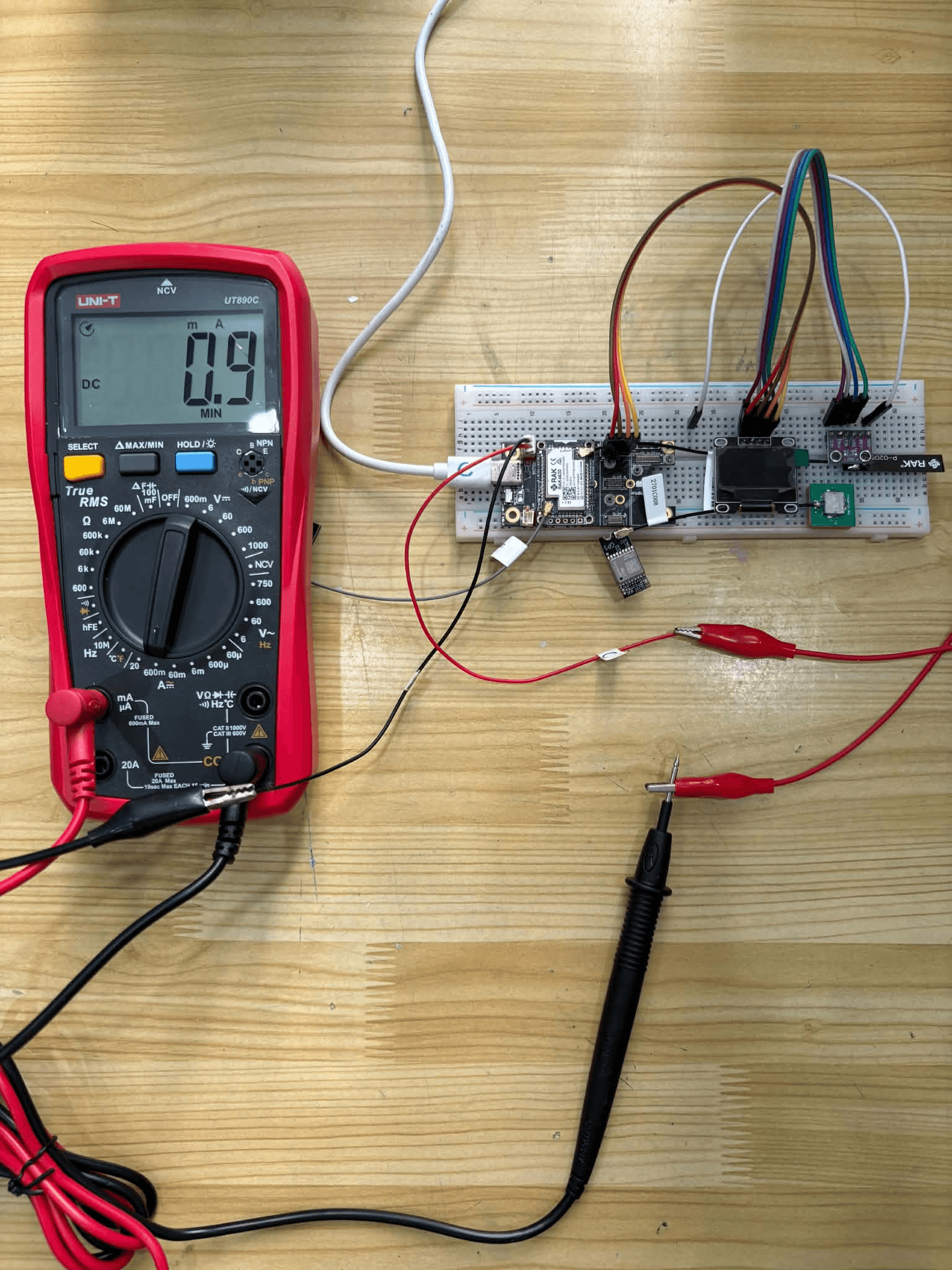
Numbers below come straight from the PowerSaving 17 release notes.
RX PowerSaving: The Headline Feature
Until now, EasySkyMesh’s power saving mostly worked by trimming everything around the radio. The radio itself still had to sit there listening. PowerSaving 17 changes that. LoRa RX now sleeps and gets woken up by incoming preambles, the same physical signature that indicates an actual LoRa packet rather than generic RF noise. That’s a real side benefit beyond the power savings: better resistance to cell tower interference, since the radio doesn’t spend as much time listening to noise it would’ve had to filter out before.
The new radio.rxps CLI controls how aggressive the sleep is:
set radio.rxps off/onset radio.rxps conservative(level 1, preamble 16)set radio.rxps balanced(level 5, preamble 16, the recommended setting; the notes list making it automatic withpowersaving onas a to-do)set radio.rxps level <1-10>for finer control, least to most aggressive (preamble 16 at SF above 8, 32 at SF 8 and below)set radio.rxps level <1-10> preamble <16|32>(preamble 32 only works with devices on MeshCore 1.16 / PowerSaving 16 or newer)
Two new diagnostic commands ship alongside it: get radio.rxps to check current settings, and get rxps.wd to see if the radio has reset due to RX PowerSaving errors.
The Numbers
Measured with a Uni-T UT890C multimeter, per the release notes:
| Board | Off | Powersaving On | Balanced | Level 10, Preamble 16 |
|---|---|---|---|---|
| RAK4631 repeater | 8.8 mA | 6.0 mA | 2.4-5.8 mA | 0.9-6.0 mA |
| Heltec T114 repeater | 14 mA | 7.9 mA | 3.4-7.5 mA | 1.6-7.3 mA |
| Heltec T096 repeater | 15.3 mA | 9.1 mA | 4.6-8.8 mA | 2.8-8.4 mA |
| Heltec V4.2 repeater (FEM always on) | 50 mA | 14.5 mA | 9.9-13.9 mA | 8.0-13.4 mA |
| ProMicro nRF52840 + SX1262 | 14 mA | 7.9 mA | 4.7-6.2 mA | 2.6-4.7 mA |
| T-Echo Lite BLE companion | - | 9.6-13.4 mA | 4.7-13.4 mA | - |
| T1000-E BLE companion | - | 15-17 mA (USB) | 13-14 mA (USB) | - |
IoTThinks estimates 30-50% additional power savings compared to PowerSaving 16 across the board, on top of whatever PowerSaving 16 already saved over stock MeshCore. The RAK4631’s 0.9 mA floor is the standout, but the pattern holds across every nRF52-class board in the table.
Catching Up: PowerSaving 16 and 16.1
We didn’t cover the last two releases, so a quick catch-up before 17. PowerSaving 16 (June 8) brought proper hibernate mode for ESP32 BLE companions down to 16 uA, optimized the Heltec T096 from 12 mA to 8.7 mA, and added a reboot.interval CLI so repeaters can auto-recover from unexplained hangs. PowerSaving 16.1 (June 29, with several point updates through late July) extended power saving to GPS: repeaters can now sync time with GPS while keeping it off most of the day (GPS stays on for up to 10 minutes, turns off as soon as it gets a valid time sync, then stays off for a day), and BLE companions get GPS power saving automatically when location is enabled in the MeshCore app. Coverage grew steadily through July to include T-Beam, RAK/GAT562, Seeed T1000-E, and Heltec Mesh Solar and Tracker boards. If you skipped straight from 15 to 17, you picked up all of this along the way.
Notices and Caveats
GPS on RAK3401, RAK12500 (I2C), and RAK12501 (L76K) is marked BETA in this release. If you’re running GPS on one of those, you’re testing, not deploying to production.
One report of reduced range at 100 km on Xiao nRF52. IoTThinks is investigating. If you hit this, the workaround in the release notes is powersaving on combined with set radio.rxps off, which gets you the rest of PowerSaving 17’s improvements without the RX sleep behavior that’s suspected in the regression.
Credit where it’s due: the RX duty-cycle work traces back to a contribution from Mr. Dom4n (IoTThinks/MeshCore#11), with IoTThinks and the wider PowerSaving testing community doing the board-by-board verification.
How to Flash
Upgrade existing devices. Download upgrade.bin from the release (nRF52 boards use the .uf2 or .zip files instead).
Fresh installs. Download freshInstall-merged.bin.
Heltec V4 binaries cover both V4.2 and V4.3. A separate V4.3-only binary exists too, and both V4.3 and T096 have FEM RX gain on/off variants, so pick the one matching your prior setup. Full instructions: Flash Custom Firmware Guide. Source: PowerSaving-v16 branch (the branch name lags the release number; this is the correct source for 17).
Download EasySkyMesh PowerSaving 17.
Should You Update
Yes, especially if you’re running RAK4631, T114, or T096 repeaters on battery or solar. The jump from PowerSaving 16 to 17 is 30-50% on top of an already-optimized baseline, and the interference resistance from preamble-triggered wake is a real secondary benefit, not just a power number.
Start with powersaving on and set radio.rxps balanced as your baseline. Only push to level 10 if you’ve confirmed your link budget can tolerate the wider sleep windows, since that’s where the Xiao nRF52 range report came from. Test on an easy-to-reach node before rolling any new rxps level across a rooftop fleet, same advice we’ve given for every EasySkyMesh release.
If you’re running GPS on RAK3401, RAK12500, or RAK12501, treat this as a beta test, not a production rollout, until that stabilizes in a future point release.
Support the Developer
Power optimization at this level, board-specific tuning across a growing hardware list, and the testing effort behind every number in that table. If EasySkyMesh is running anywhere on your network:
- PayPal: paypal.me/iotthinks
- GitHub Sponsors: github.com/sponsors/IoTThinks
Newer PowerSaving builds, and every earlier one, are listed in our EasySkyMesh release tracker.
This post covers community firmware built on MeshCore. NodakMesh isn’t affiliated with EasySkyMesh or IoTThinks. We highlight ecosystem work that makes mesh networking more practical for everyone. We haven’t covered MeshCore 1.16 directly, but our MeshCore 1.15 post and the PowerSaving 15 post cover where this series started, and our MeshCore 1.17.0 post covers what’s shipped upstream since.
Comments
Related Posts

EasySkyMesh Power Saving 14.1: Heltec V4.3 at 5.5 mA
EasySkyMesh 14.1 brings Heltec V4.3 support at 5.5 mA idle, FEM LNA toggle for 1W boards, powerlog CLI, and nRF52 companion savings to 5.8 mA.
EasySkyMesh PowerSaving 18: Beta on MeshCore 1.18
EasySkyMesh PowerSaving 18 is a beta on MeshCore 1.18 that turns power saving on by default for new installs. What changed, which boards, and known issues.
EasySkyMesh PowerSaving 15: ESP32 BLE Companion at 15-20 mA
EasySkyMesh 15 brings ESP32 BLE companion power saving, no-time-drift on repeaters, and a May 4 hotfix. Built on MeshCore v1.15.