Meshtastic Firmware 2.7.18.fb3bf78 Alpha: What's New
Meshtastic alpha 2.7.18.fb3bf78 adds multi-message storage, API port config, Rak3112 support, and InkHUD joystick nav for the Wio Tracker L1.
On this page
Meshtastic alpha 2.7.18.fb3bf78 was published on January 22, 2026. It’s a precursor to the next stable release, so this is the build for people who want to test the new features and are comfortable reporting issues back upstream.
The notes below come straight from the release changelog. If you’re running this in the field, we’d love to hear what’s holding up and what isn’t.
What’s New
Multi-message storage. This is a change to the on-device screen UI (BaseUI), not to how packets are sent. The node now keeps the last 20 messages in RAM, saves them to flash on a proper reboot or shutdown (not a hard power cut), and restores them on boot. Messages show in threaded conversation views (channels, DMs, or all), and sent messages get a status mark: a checkmark for a confirmed ACK, an X for failed, and an exclamation mark for relayed with no ACK.
API port now configurable from the config file. This one is for Linux native nodes (meshtasticd). The API port can now be set as APIPort under General in config.yaml. A port given at runtime still wins, and the default stays 4403. Useful if you’re running multiple services on the same machine.
Rak3112 module support. The firmware now recognizes the Rak3112 as a build target. If you have one of these modules on a shelf waiting for official support, this is the release that unlocks it.
PMSA003I refactor and AQ telemetry update. Mostly internal reorganization. Moving the PMSA003I air quality sensor to its own class makes the telemetry pipeline cleaner going forward. The same change adds logic to put the sensor to sleep and wake it, which matters because PM sensors can draw 200 mA or more on boot.
InkHUD joystick navigation for the Wio Tracker L1 e-ink. If you’re running a Seeed Wio Tracker L1 with an e-ink display, joystick input now drives the InkHUD UI. Cleaner standalone operation.
Also in this alpha. The changelog is long. A few more lines worth knowing: unified OTA firmware for ESP32 boards, support for the LilyGO T-Echo Plus and LilyGO T-Beam 1W, preliminary ThinkNode M4 support, a custom LoRa coding rate setting, mute options for channels and nodes, and an LNA/PA power control fix for the Heltec V4 and Wireless Tracker V2.
What to Test
If you flash this alpha, a few things worth watching:
- Do stored messages come back after a clean reboot, and do the threads sort DMs and channel messages correctly?
- On meshtasticd, does the
config.yamlAPI port take effect, and does a runtime port still override it? - Wio Tracker L1 users: does the joystick nav behave the way you’d expect it to, or are there rough edges?
The full changelog is on the Meshtastic GitHub releases page. Read it before flashing. Alpha builds aren’t meant for mission-critical nodes.
Who Should Flash This
If you run a dedicated test node or you have a spare device on the bench, this is the kind of release you pull down to help shake out regressions before they reach stable. The community feedback is what moves these fixes into the next stable release.
If your nodes are part of a live mesh your group depends on, wait for stable. Alpha means alpha.
Comments
Related Posts
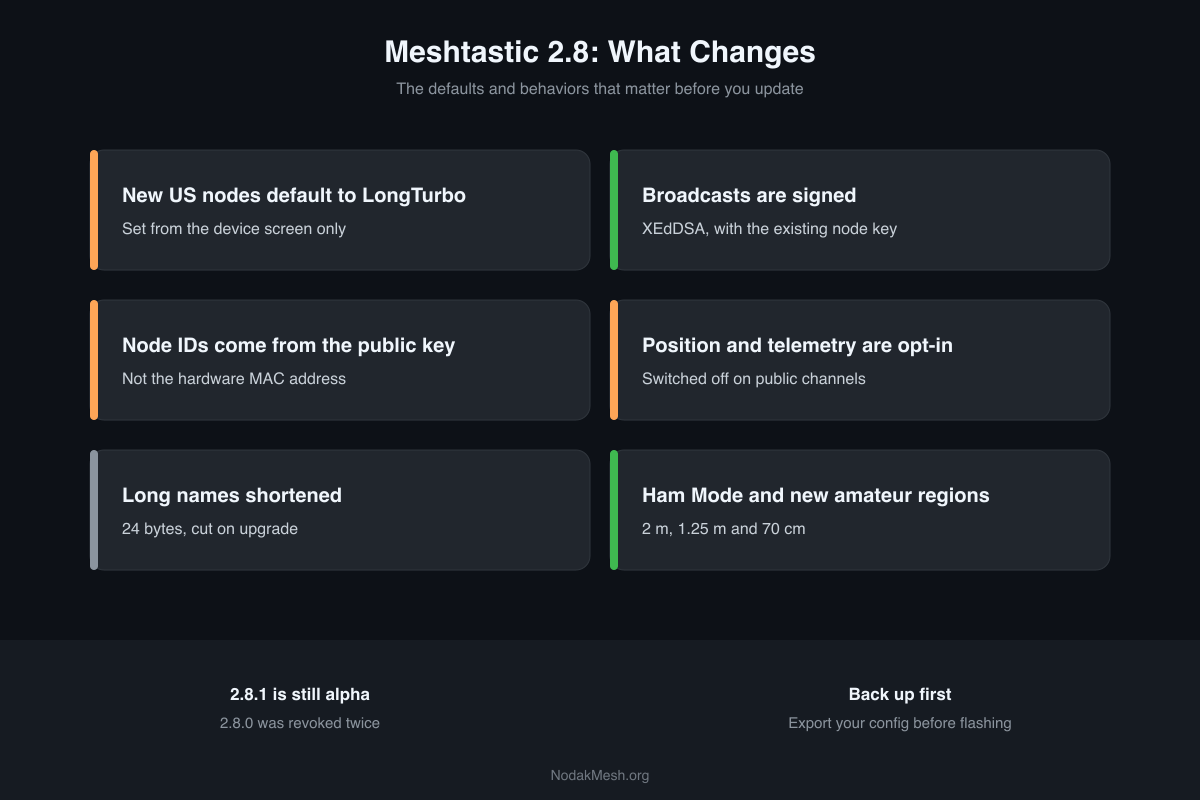
Meshtastic 2.8: What's New and Should You Update?
Meshtastic 2.8 changes US presets, signs broadcasts, gives nodes new IDs and makes position sharing opt-in. What changes, what breaks, and when to update.
Meshtastic 2.7.21 Alpha: HTTP Deprecation and LNA Default
Meshtastic 2.7.21 alpha deprecates the HTTP server on original ESP32, flips LNA on by default for Heltec V4.3, and adds a RAK 13302 gain table.
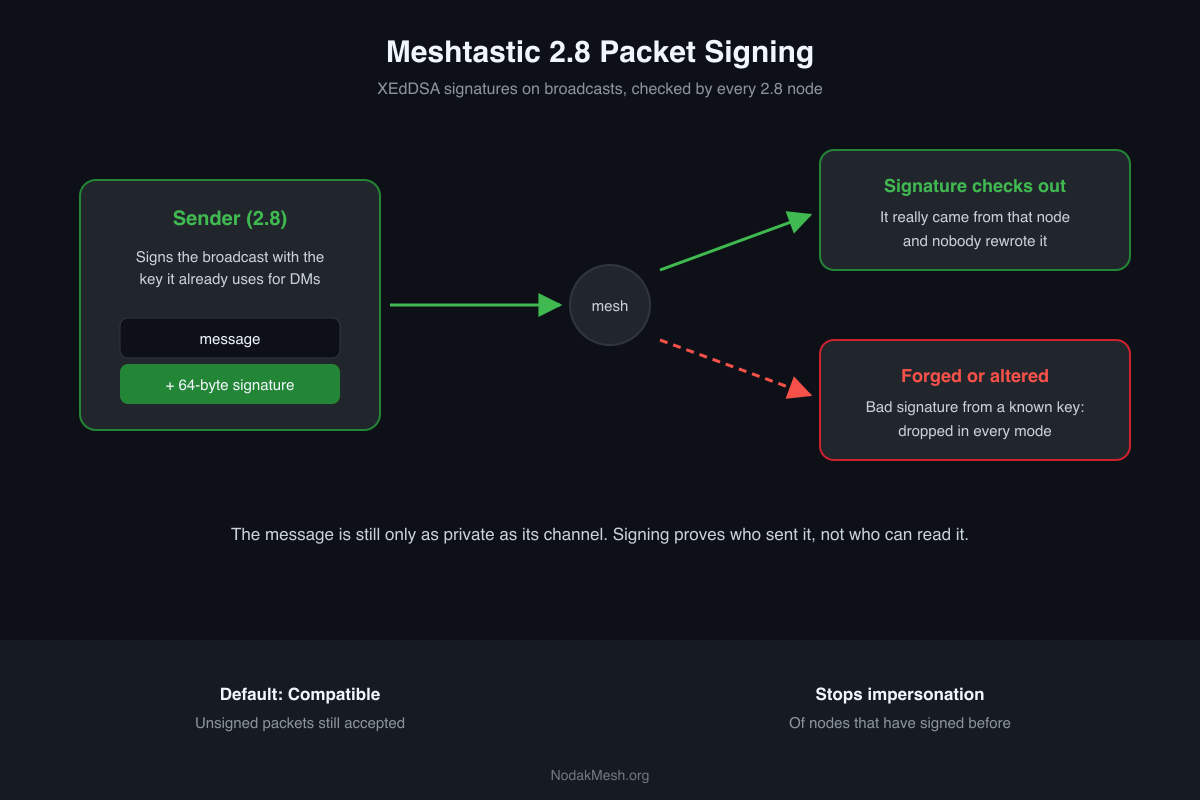
Meshtastic Packet Signing Explained: What 2.8 Protects
Meshtastic 2.8 signs broadcasts with XEdDSA. What a signature proves, what it doesn't, the three receive policies, and why 2.8.0 was pulled.